Dad’s Mustard Brisket

Of all the things I cook, the most requested recipe is brisket. As a Texan, it should be required in order to graduate high school to know how to properly cook a brisket. It doesn’t have to be smoked, but right before they hand you a diploma, if you can’t answer “slow and long” to the question of how a brisket should be cooked, they should send you back to class.

My brisket is a world-stopper. You’ve never had BBQ quite like this, and the key is yellow mustard. Not fancy brown or Dijon mustard, but plain ol’ French’s mustard. Here’s my secret, though: This isn’t my recipe. It’s my dad’s. When he first told me how he was doing his brisket, I just about squeezed my eyeballs out of my head squinting at him. Sure enough, though, he was right. He’s right about a lot of things that I challenge him on, but none moreso than mustard brisket. Here’s to you, dad.

I’ve never officially gone thru this procedure before because of one major component, and we might as well tackle it head-on right out of the chute. To properly cook a brisket, you’ve got to dedicate an entire day to doing it. Not a “day” as in “when the sun is up”, rather a full 24 hours. An entire rotation of the friggin Earth. If you aren’t willing to put in the time, sacrifice some sleep, and do this right then don’t bother with it. Go get yourself a nice margarita and rent Brokeback Mountain. When you get started on this, take notes of time and do it right. Don’t come bitching to me if you pull this thing after the sun goes down and it tastes like shit. Not my problem. You’ve been warned.

Your timeline is:

Day 1: Brine for 4-6 hours, up to overnight

Day 2: Marinate overnight

Day 3: Smoking

4-6 hours unwrapped

12-14 hours wrapped

4-7 hours in the cooler

Example:

1) Put the brisket on at noon unwrapped

2) Wrap it at 6pm

3) Put it in the cooler at 7am

4) Serve at noon.

24 hours.

Good so far?  Good.

Now that we have the unpleasantness of the requirements out of the way, let’s get to the basics of Texas BBQ beef. The brisket was just a trash piece of meat until just a few decades ago because no one knew how to cook it right. For reference, picture a delicious bovine:

The brisket is the cut just above the front legs. Think of it as your chest if you were to get down on all fours. Because of where it is, more than half of the entire body weight of the animal sits on this piece of meat. Therefore, it has to be strong, long meat fibers that are filled with fat and connective tissue. In addition, there are three different muscles that come in, and therefore three different meat fiber directions. This makes things really difficult to manage, especially when it comes to cutting the finished roast.

Ranchers would just toss this thing because it was so hard to cook. There’s an entire cap of fat on one side, and all three muscles are separated by  layers of fat and membranes that are really deep and hard to get to before it’s cooked. Even then, you can easily mess up the presentation by cutting it wrong. The direction of the cut is almost as important as how it’s cooked. About 50 years ago, though, ranchers started noticing that their Mexican hands were taking the briskets and making incredible dishes with them. They figured out that what they were doing was cooking it over low heat for a long time in a braise. They took the braised meat and cooked it over dry heat, and the modern Texas BBQ was born.

Now that I’ve officially scared hell out of you for cooking this thing, let’s get things prepped. We’ll need:

-an untrimmed brisket. UNTRIMMED by the butcher, that is. Don’t get a trimmed brisket.

-Bottle of Allegro marinade

-French’s yellow mustard (generic will do; I’m using French’s here so you see it’s not anything special)

-An oven bag

-Your favorite BBQ rub

That’s it. Not a whole bunch to this thing. Your brisket needs to be untrimmed. Competition BBQueers will try to tell you to trim a brisket, but that’s just because they are trying to skip on time. Keep it untrimmed…we are going to need as much fat as we can get. What size?  Hell, I don’t know.  About this big will do:

Doesn’t really matter. When you go to pick it out, what you are going to be looking for is a solid cap of fat on the backside of the brisket (they always put the label on the opposite side because it’s prettier). I had someone tell me one time that they went to Central Market and bought a “prime” brisket. I’m not sure that it even exists. This is meant for trashy cuts of beef, so the sinewy-est, fatty, marbled up slab of brisket you can find is perfect. If you spend more than $2.50/lbs for your brisket, you got taken. Look for it on sale, and buy it when it’s around $1/lbs and freeze it.

Take your brisket out of the plastic and rinse it under water to get off all the extra blood. Let’s examine:

You see the long meat fibers here? They lie just under that membrane on top of the meat. Don’t peel it off…I just want to point out how the meat runs for later. We are going to cut AGAINST the grain when we serve.

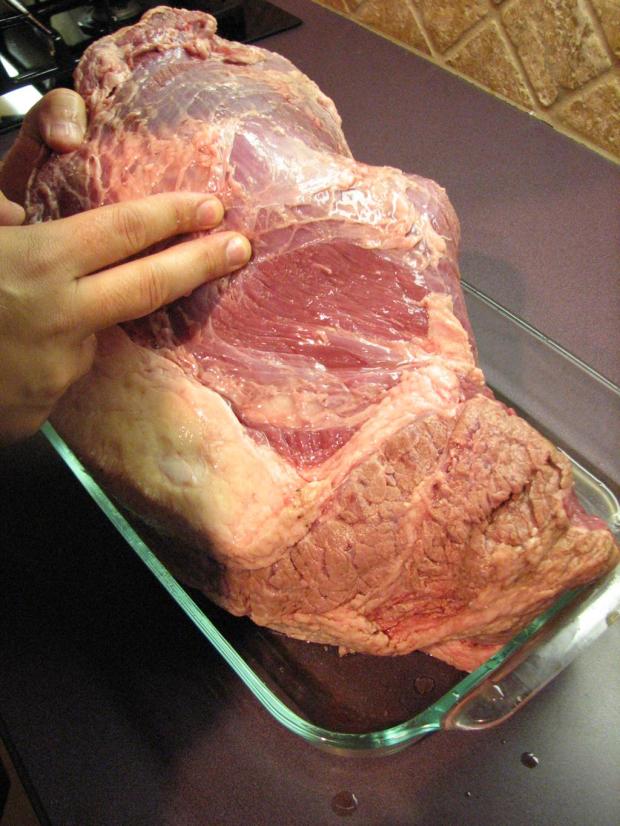
I pulled back that membrane a little bit to get a good shot. See how the direction of the fibers curves away? When we start cutting, we’ll need to look for that, and stop when we get to the point where we aren’t cutting against those grains.

The fat cap:

One of my favorite tools is the Reynolds turkey bag. They are just plastic bags that you can marinate/brine your meat in. Take one out, and put your brisket in, with the fat cap side DOWN.
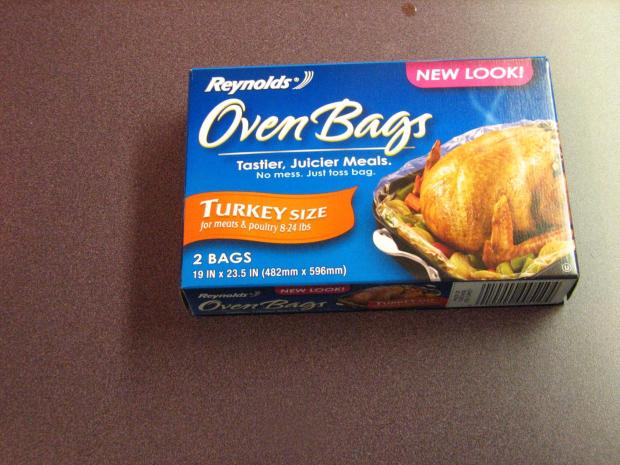
I like to put it into a pan in case there’s a leak in the bag, and there’s always a leak in the bag.

Now, take that Allegro marinade and pour in enough so that it comes up about halfway up the brisket.

Make sure that it’s the fat cap side that’s down, and not the meat fibers. What we are trying to do is use that salt and acid that’s in the Allegro to break down the fat and the muscle fibers around the fat. If you brine this with the meat side down, you are going to turn the meat into mush, and we don’t want that. Seal up the back and put into the fridge for 4-6 hours, up to overnight.
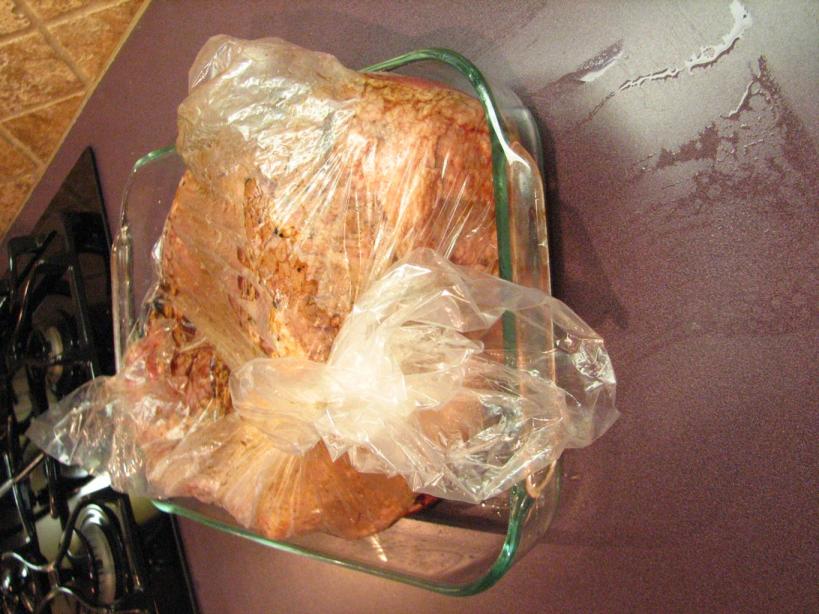
When you are finished, pull it out and lay it into a pan big enough to hold the whole thing. This is key…you are going to be flipping it in just a bit. Start with the fat cap side DOWN.

Get your yellow mustard out and squeeze LIBERALLY all over this thing, and then smear it with your hands so that it’s thick all the way around. Go ahead and rub it in kinda hard into the cracks and crevices where you can get your fingers. I always start mine out right:
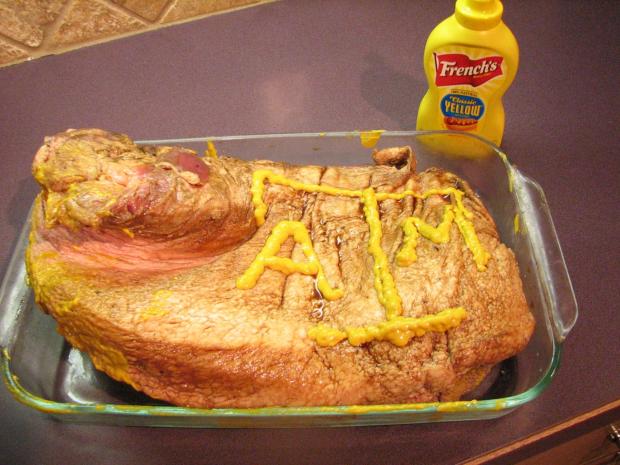
Coated:
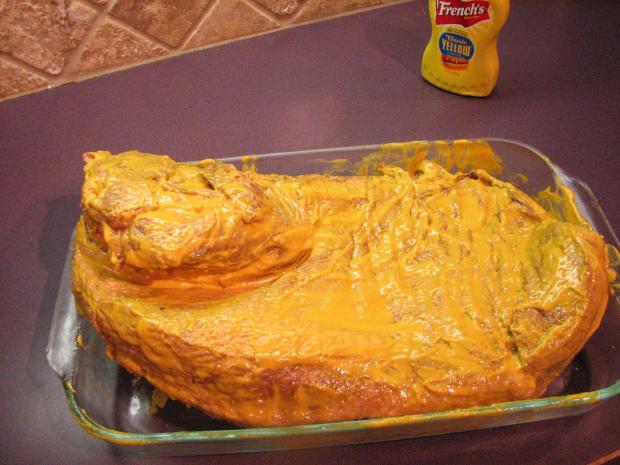
When you get a good thick layer on it, grab your favorite bbq rub and sprinkle it LIBERALLY all over. You don’t have to use the Arcadian Rub, but you want to make sure you use one with some brown sugar, salt, and spicy cayenne. You know what? Just use the damn Arcadian Rub.

Flip it over and get the other side as well (fat cap back down). DON’T RUB IT. Just sprinkle on top of the mustard. If you’ve disturbed the mustard coating, make sure it’s even and then re-sprinkle to cover.
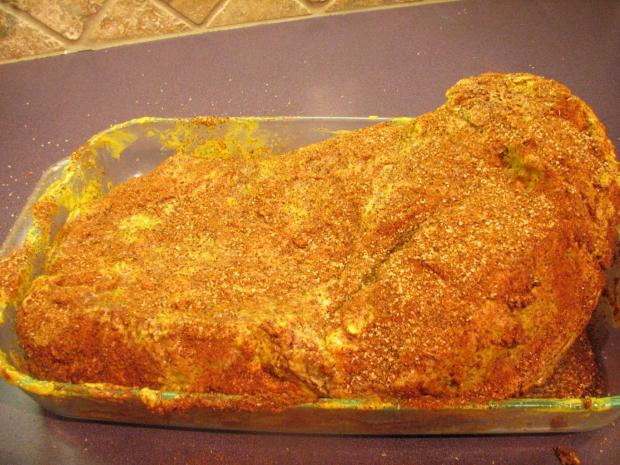
A close-up:

Now, we need to put this back into the fridge overnight. Don’t skimp. Needs to be overnight. If you put it in unwrapped, though, your fridge is going to smell like this for weeks, so grab a new trashbag (unscented) and put the whole thing in, pan and all. Seal it up and let it sit in the cold.
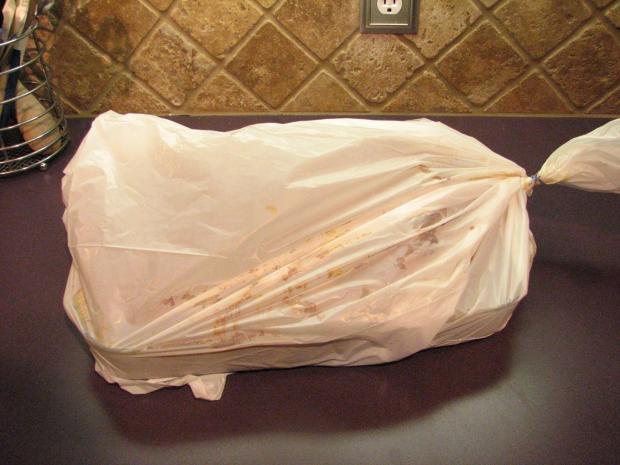
After a night in the fridge, poke that bad boy’s head out and take a look. The rub has gotten wet with the mustard and has made an incredible coat around the meat. That will be important for the next few hours as we slow smoke this

Close-up:

When you take it to your smoker, make sure you’ve let your smoker go enough so you are regulated to about 225deg constantly. Don’t try to singe this or sear it at first. It’s totally unnecessary, despite what you may hear from BBQ “experts” on tv. Just make sure you have a hard rolling smoke going, and your temp is around 225deg. 250deg at the highest.

I’m using mesquite.  Not pecan and especially not oak, which is good for firewood and that’s about it.  Use mesquite wood on your beef.  I could almost accept someone mixing in some pecan, but it’s not needed.  Just use mesquite.  Stop asking questions.  Use mesquite.

Put it into the grill with the fat cap UP. UP.

There are differing opinions on whether or not you should smoke fat side down or up. The folks who say “down” say that it helps keep the meat from charring. However, it you run your smoker right, it should never char since we aren’t getting above 250deg. Also, if the cap of fat is up, then it will melt down inthru the meat fibers, coating them with the delicious fat and Allegro brine. Does it matter? In the long run, probably not. However, this is how I do it and I know it works. Try it this way and see if it’s not good. If not, do it however you want to do it. This is America, baby.

After 4 hours:
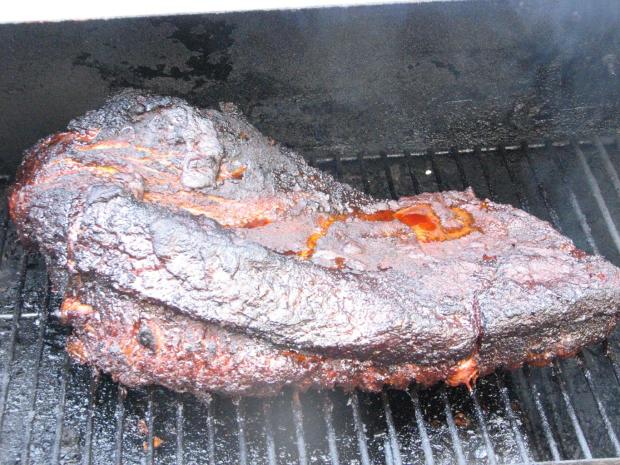
After six hours (with a couple of sweet potatoes thrown on to smoke for dinner):

You notice how black it is? That’s GOOD. We call that “bark” in the BBQ world. It’s the blackened layer right around the outside that has all the seasoning flavor from the mustard mixed with our rub. After six hours, we need to wrap this. You can go a little longer if you like, but I think six hours is plenty.

Get your handy prep table out, and lay two layers of heavy duty foil (the long package). Lift your brisket right out of the grill and onto the foil.

Fold the first layer of foil around the briskets. Fold it TIGHT and do it so that all corners are covered. I start at the bottom, fold across like you are putting a diaper on a baby (old style diaper on a baby, that is).

Do both ends, tucking in each loose piece, pinching them together, and making sure they are sealed up TIGHT.

When you get it all sealed up, a nice fold or pinch will keep it together. Just like a good marriage.

You might have some spots left exposed after the first wrap. No worries..we’ve got three more layers to go. Second layer from the bottom:

After both bottom layers go on, take another large piece of foil and wrap all the way around the top, covering that hole at the top, tuck under, but make sure you fold corners so that it fits like it should. Do that twice. You should have used four sheets of foil so far.
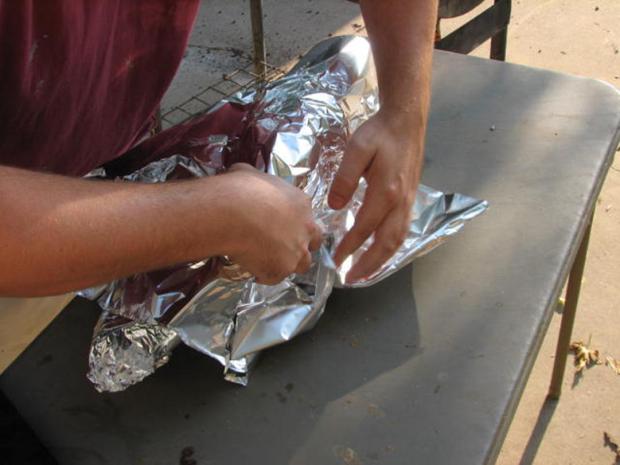
Then you’ve got your tight wrapped brisket, ready to go on for the long burn. Again, make sure you are watching your fire constantly and keeping it between 225-250deg.
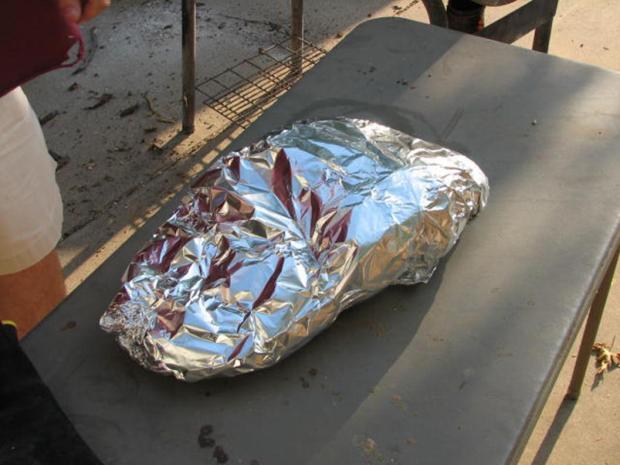
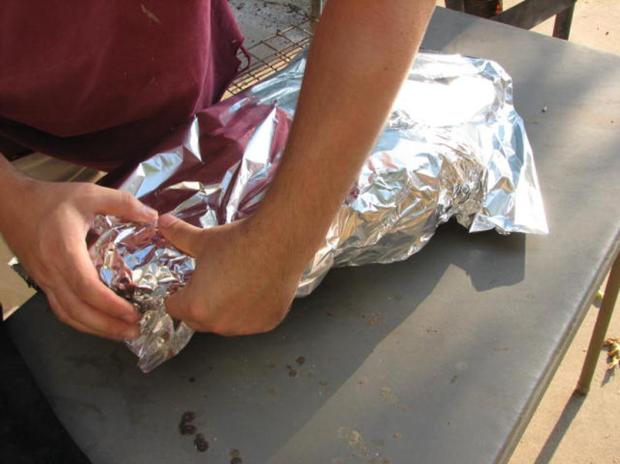
Back on it goes. Let’s add up the time so far:

-Allegro brine (4-6 hours, potentially overnight)

-Mustard and rub down (overnight)

-4-6 hours on the smoker at 225-250deg.

Up next, this needs to go for 12-14 hours wrapped at the same temps. Crazy, right? Yeah, just trust me on this.

After the smoker has done it’s work, the pretty foil will go from a nice golden yellow to a dark brown.

After 12-14 hours, take the entire brisket and place it in to your BBQ Cooler and let it rest for up to seven hours.

Do NOT open the cooler or disturb the foil until you are ready to cut.  That’s important.  Let it rest, and the rest is just as important as the other steps.  Don’t skip on this…let it rest.  Up to 7 hours max, no less than 4 hours.

When you are ready to carve, here’s a little trick.  You’ve got the fat side up still, so reach into the cooler and either rip the foil with your fingers or take a knife and cut the foil open.  You should be able to pick it up from underneath and flip it out onto your carving board.  However, get a pan so you can collect the drippings before you flip it out.  I use the same pan that I used to marinate the brisket.  Just tip it so the drippings run out, flip your brisket out onto your board, and then collect as much of the drippings as possible.  If you have some drippings that come out onto the board, go ahead and try to rake those into your pan also.  It will make the carving so much less messy.

Big ol’ slab of beef.

From the bird’s eye view:

When you start to cut, keep in mind how the meat fibers run.  Again, we are going to cut against the grain.  There’s a little secret to make sure you do this correctly.

a) start at the “skinny” end of the brisket

b) start on one corner, where you think you need to start

c) cut off the top of the corner on a bias (or on an angle) to make sure you are starting right.  If you chose the wrong corner, you can easily go to the other corner w/o too much of a do-over.

How do you know if you’ve cut it against the grain?  The part you cut should fall apart, with the meat fibers being really short.

I like to use an electric knife.  Honed steel is good, but don’t foresake the precision of an electric knife here.  Start making about 1/4″-1/2″ slices along that same line that you started on just a bit of a bias.

Excuse the blurriness, but you get the idea.

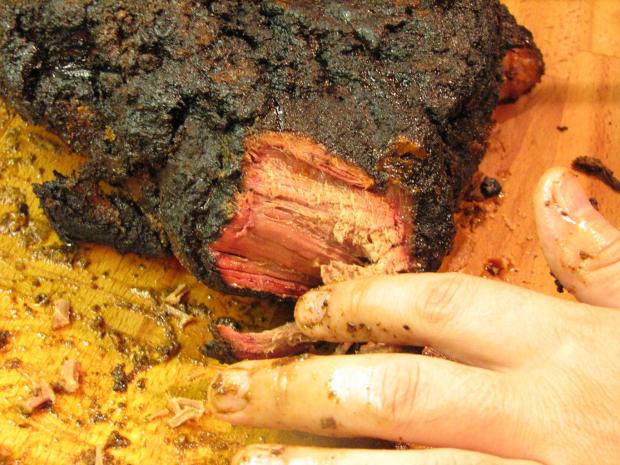
This is what I’m talking about being “against the grain”.  See the short meat fibers now that seem to fall apart?  That’s what you want.  This will be so tender that the meat will literally fall apart when you try to pick it up.

Here’s your brisket slice, about as whole as you can get it.  It’s ok if it falls apart.  It’s going to be so good and tender, it doesn’t matter if it stays in long slices.
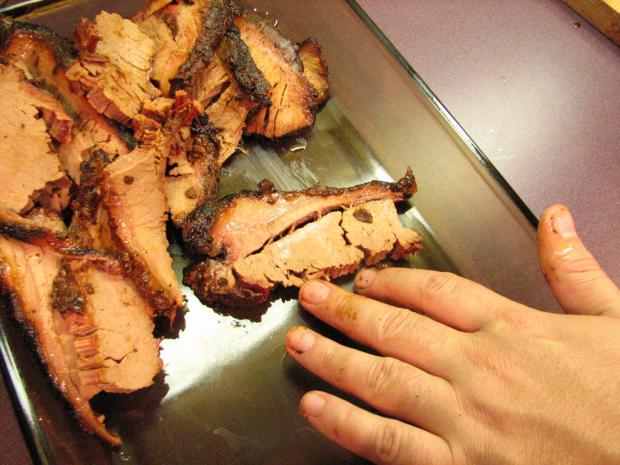
Continue on until you get to the point where the meat fibers begin to turn.  You’ll know you are there when you get to the big thick part of the brisket, and your slices look like they are slanted.  Then, turn the brisket 90degrees and start cutting right across the top, which will now be against the grain.  You’ve got two different muscles in here, but they’ll both be going the same way.

A close-up of the muscle, with a thin membrane separating.

Here are the long meat fibers.  Cut against then so your knife is perpendicular to the muscles.
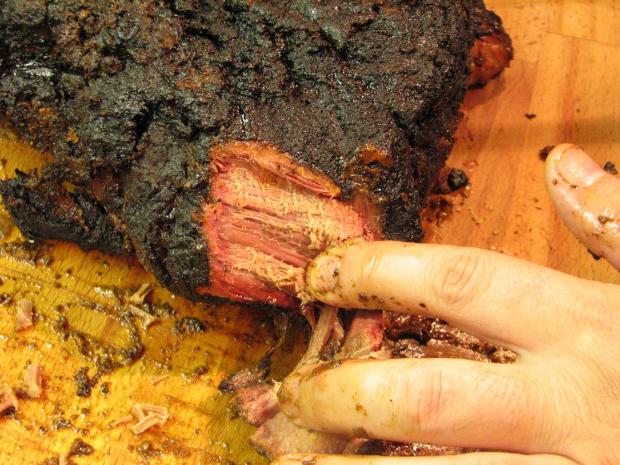
Close-up, of the slices.
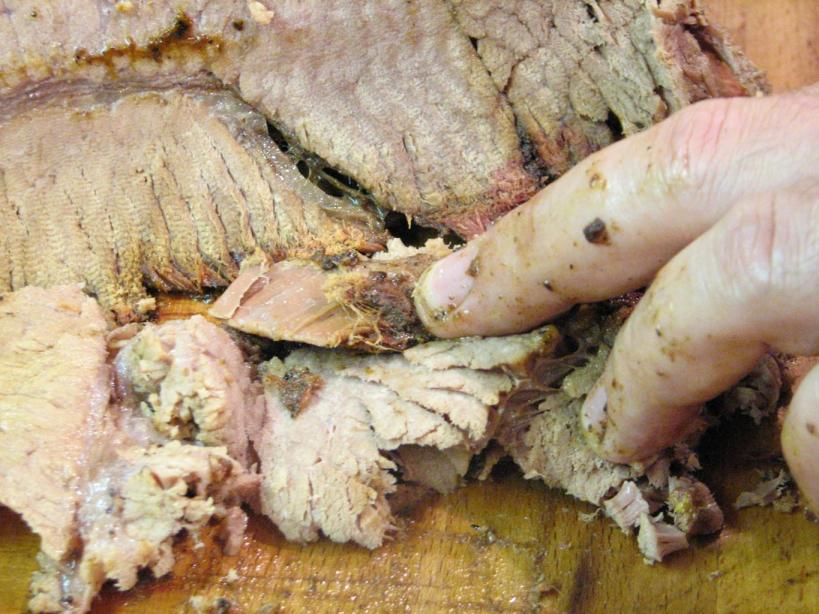
When it’s all sliced up, you have should be able to peel some of the extra fat off and keep it in a pile up at the top.  Plus, you have tons of extras left over.

There’s all the brisket cut up.

That fat still has tons of potential to it.  Let’s not throw it away.

If you take your fat trimmings and put them into a skillet, you can start to render some of the extra fat off.  Brown on both sides for a bit…
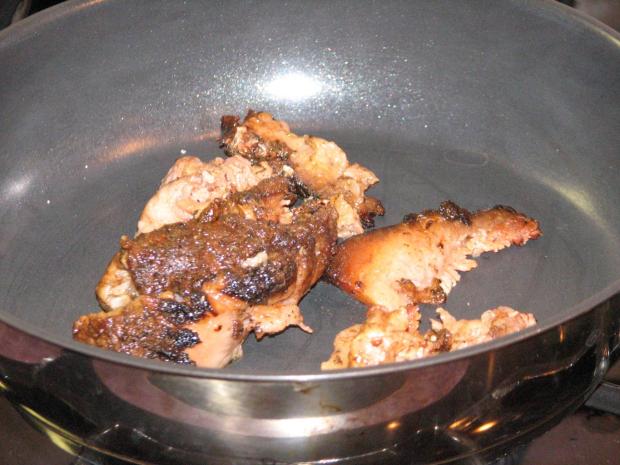
Then add a little beef broth or some of the drippings back to the pan and let it suck as much of the fat out as possible.

Then take that hot grease and drippings and pour it right back over the sliced brisket.  Cover it with foil, put it into the oven at 170deg for a few minutes just to keep warm until it’s time to serve.

Presentation on the plate:
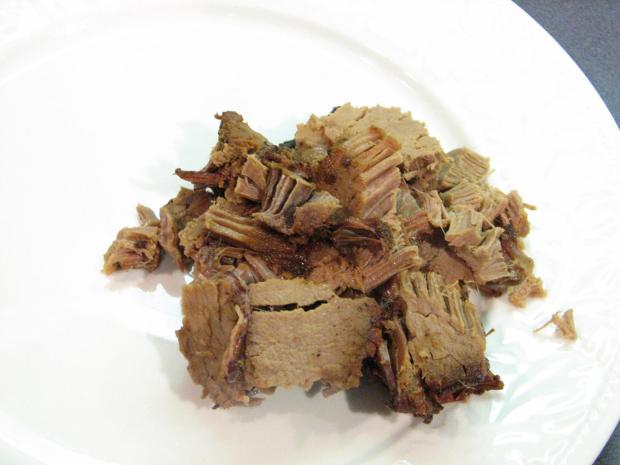
In the pan, you’ll have this deliciousness:

I’m not opposed to putting sauce on this, but if you are going to use sauce, let’s use the WGD brisket sauce and not just some sugary sweet crap off the shelf.

That’s it.  My dad’s mustard brisket, cooked for a full 24 hours and about as perfect as Texas BBQ can be.

The Best Soup I’ve Ever Tasted

I love soup, and when the weather starts turning cool I try to eat soup as often as possible. A lot of people will choose the salad when given the choice, but I often go with the soup as a first course, especially if it’s all made from scratch.
My three favorite soups:

3) Cream of Artichoke soup at  The Messina Hof Vintage House in Bryan, Texas. The restaurant there is hit or miss, but the cream of artichoke will change your life.
2) Red Chicken Curry at Samui Thai in Plano, Texas. I judge thai food joints based on their curry, and Samui always is rock solid.  The bamboo shoots and aubergine are incredible.  I’m not sure if you can really count this as a soup, but it’s my list so I make the rules.

1) Chicken and Mushroom soup. Right here, right now. Buckle up.

Here is the ingredient list (for the most part):

Make a classic mirepoix, which is diced onion, celery, and carrot. I cut these in random sizes for texture. Melt 3tblsn unsalted butter and then throw in the mirepoix and salt. Caution: you are going to add a lot of salt to this dish, but you want to do a little as you go. The salt will help reduce the vege.

Once the carrots start getting soft, add a bunch of garlic. I did four cloves here, but you could go with more if you are a garlic geek. Keep it moving so it doesn’t burn. We are going to use three types of mushrooms here: shitake, oyster, and plain ol’ white button mushrooms, all sliced in a rough chop. Clean the mushrooms WITHOUT water (rub them down w/a towel to remove the dirt). Once you get them sliced, toss them in. Shitake:

Oyster:

Button:

And into the pot with more salt. The shitake have this great beefy taste, the oyster a buttery chewy taste, and the buttons are just a great all around mushroom. If the vege start to look dry, add a little bit of olive oil. It should look like this:

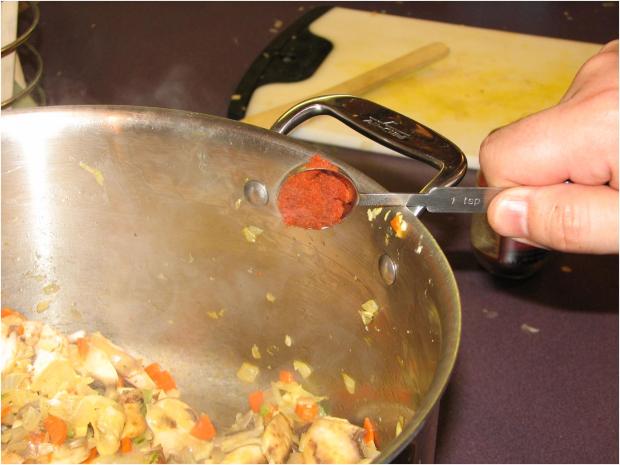
When the mushrooms all start looking soft, add a tspn of red curry paste.

This is what I use. Now, it’s not a thai dish, but we do want a bit of the thai spice that it’s hard to combine with anything other than the paste.

Add the curry paste and toss the mixture to make sure it’s good and mixed in. Let it cook down for a few minutes, then add some white wine. How much? Hell, I don’t know. About that much:

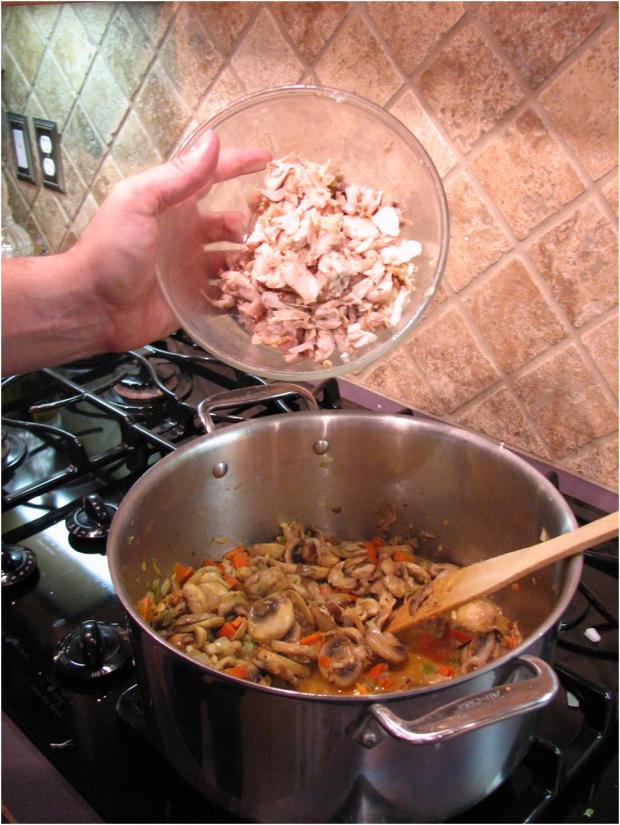
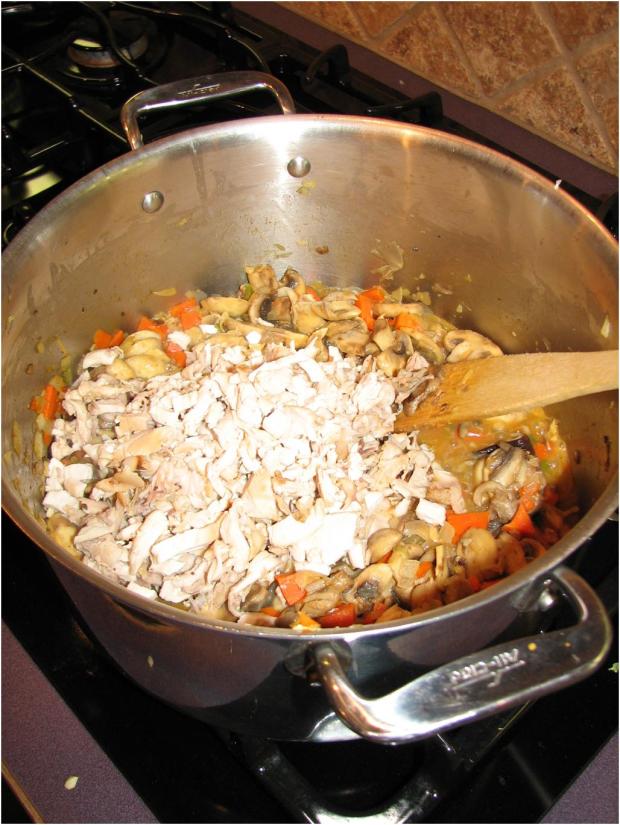
Let that simmer for about five minutes and then add ½ chicken, chopped up. I just used one of those rotisserie chickens from the grocery store. I think the flavor was Garlic Herb. By “1/2 chicken”, I mean ½ breast, a leg, thigh, and then all the dark meat from the back. That’s some of the tastiest meat on the bird.

Then add 6oz of tomato sauce.

And about 6oz of chicken broth.

Simmer for 5 minutes or so, stirring regularly. We are looking for the liquid to reduce down quite a bit. Once you get it so that you can see the moisture but it’s not standing in broth, add 1c of heavy cream:

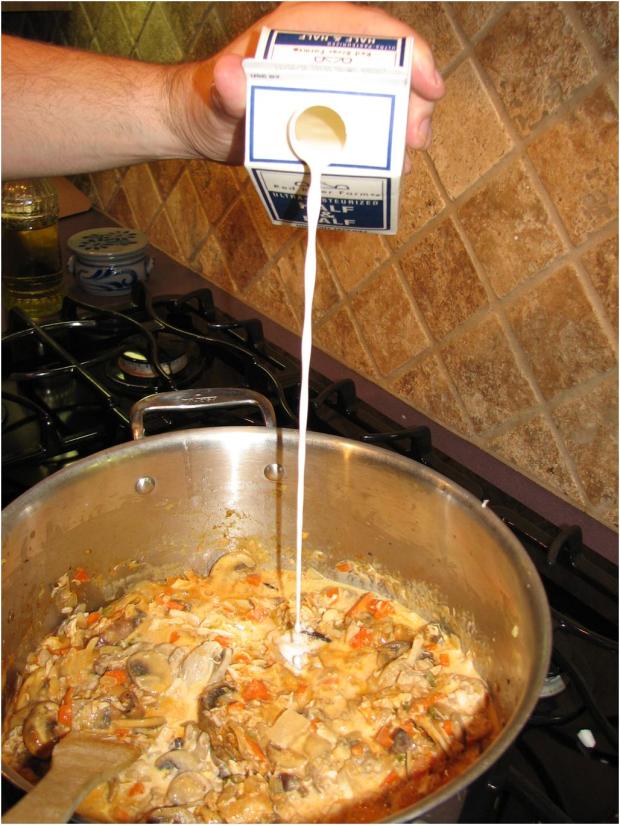
And 1c of half and half:

Of course, you’ll need to add more salt. Go ahead and grind some pepper in this as well. Let it simmer for 10 minutes or so, add chicken broth to keep the liquid at a soupy consistency. It should look like this:

Get some parmesan cheese (not the cheap powdered crap…get grated parm), and add a cup or so. How much? Hell, I don’t know. About this much:

Cut the heat down to low, and let it simmer for yet another 10 minutes.

The cheese should finish off the flavor. Toast up some French bread and sprinkle on some fresh parsley, and you have one of the most delicious things you’ve ever tasted.

That’s it. The best soup I’ve ever tasted.

Scotch Eggs,Texas-style

“I had some Scotch Eggs this morning. Man, they were incredible, ” J-Skip said to me. What the hell is a Scotch Egg? “It’s a boiled egg wrapped in sausage and then deep fried. It’s so good.”

This was the actual conversation I had with a friend of mine. I’d never heard of such a thing, but anytime you mix egg and sausage together you have a winning combo. So, out I go to the internet. Apparently, J-Skip was absolutely right. The Brits eat these things like we eat burritos here in America. They sell them in supermarkets and gas stations, and are a preferred snack for scores of limey bastards all over the UK.

I thought about this a bit, and came up with a bit of a different take on this and it worked out INCREDIBLY. What I did was mix one of my favorite sausage treats (sausage balls) with this idea of Scotch Eggs. Check it, yo:

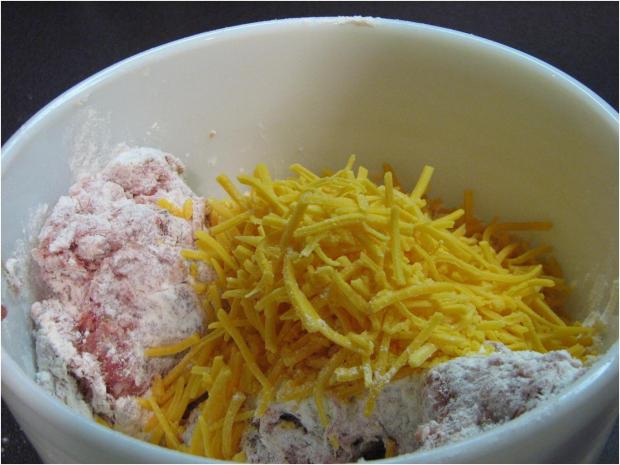
To make sausage balls, you mix a pound of sausage with 2c of baking mix and 1/2lbs of shredded cheese.

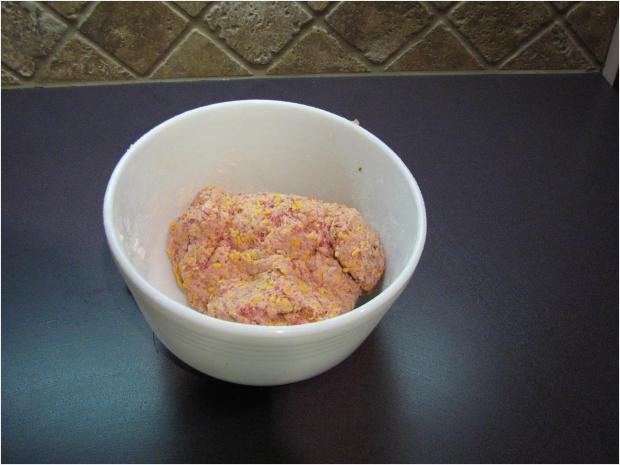
Mix these together and kneed so that you have all the baking mix “wet”. It should give you something that looks a-like so.

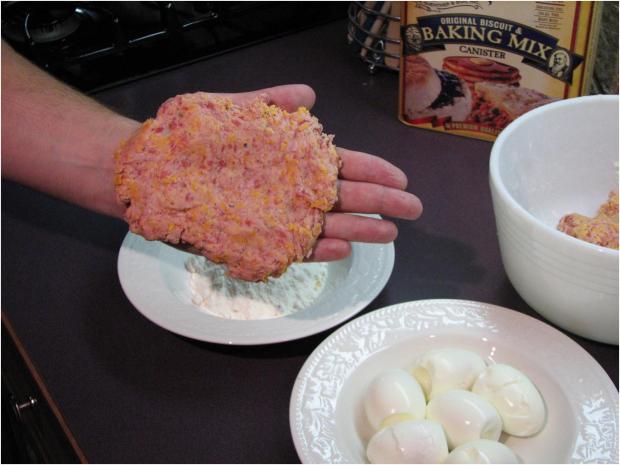
Now, normally you’d roll these into 2″ balls and bake at 350deg for 15-20 minutes until they are golden and delicious. Instead, I’m going to make a patty and push in a little concave spot the size of a boiled egg:

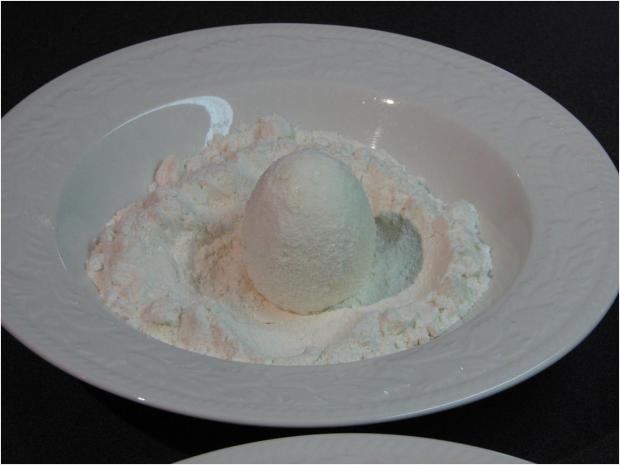
I take a little bit of extra baking mix in a bowl, and then roll a peeled boiled egg in it just to dust it a bit:

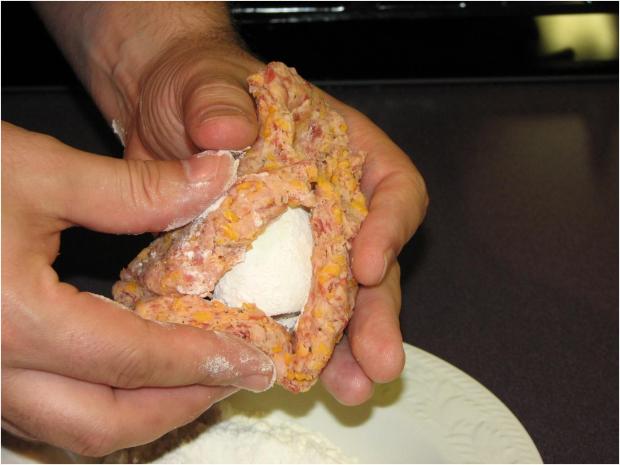
Then, let’s fold the patty around the dusted egg:

It doesn’t have to be perfect, but you want to make sure the sausage is a nice even layer around the outside and you have sealed off the holes. You’ll want it oblong in the shape of an egg so you know how the egg is laid out when you cut it open.

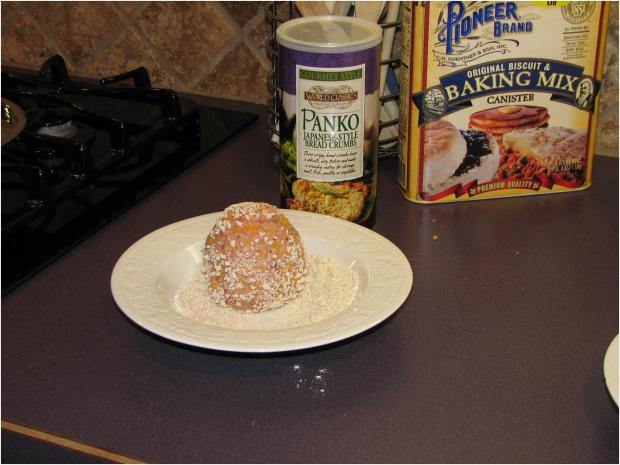
In another bowl, I put some panko bread crumbs and rolled the ball around a bit. You don’t have to have too much or any at all. It’s just for a little bit of extra crunch.

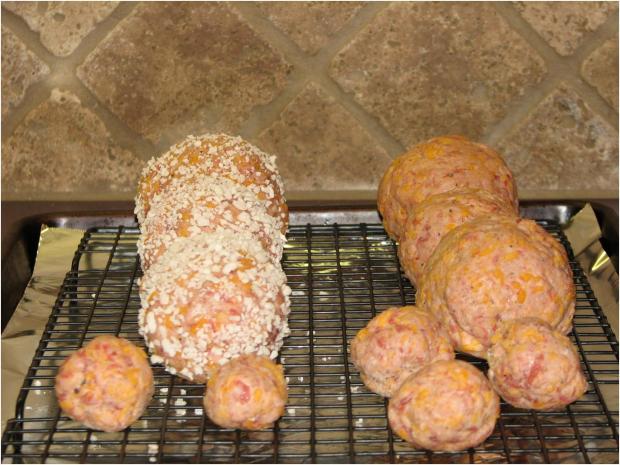
The extra I rolled into sausage balls, just because they are bite-sized and awesome. Onto a rack so the sausage can drain while they are cooking, then into the oven at 350deg until they are golden, probably about 40 minutes or so.

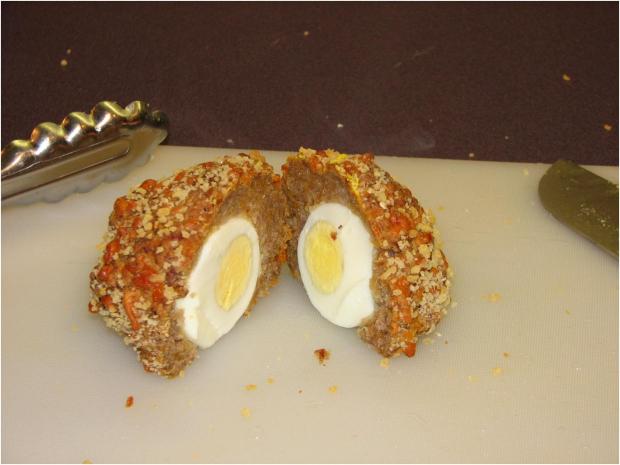
When they are finished, it should look something a-like so:

To plate this thing up, I’m going to cut it in half:

I made some quick gravy and sliced some fresh tomatoes

Toast up some bread and top with some preserves and pour yourself a big ass glass of grapefruit juice:

And then you have an instant classic here in Arcadia, the Scotch Egg.

Bob the Cook’s Pit

One of my favorite things to do in life is to cozy up with a beer on a Texas afternoon and do some outdoor cooking. It’s what Arcadia is all about…sharing what you know and do well with your friends and neighbors. In my case, I love seeing the creations that my fellow Arcadians come up with and the crazy things we make different cookers out of. My buddy down in Madisonville made a smoker out of a barrel; my dad’s fish cooker is made from an old gas water heater; and one of my favorite outdoor cookers is my plowdisc wok. I can do fajitas and breakfast tacos on that thing to feed a small army and/or a group of tailgating Aggies.

Across the country, you’ll find cooking competitions of all sorts: chili, BBQ, steaks, or even full chuck wagon competitions where you have multiple dishes as part of the submission. One of the most well-known of the outdoor cooks in our neck of the woods is Bob the Cook out at Wildcatter Ranch. Bob is an incredible gastronomist. He knows his food and knows his wine. If you ever get a chance to make your way to Young County, Texas, make sure you stop by Wildcatter Ranch and let Bob pair up a bottle of his favorite wine from his extensive wine list with a slab of medium-rare Texas beef and then top it off with his banana pudding in a Mason jar.

Bob the Cook (or “BtC” as we like to refer to him) recently catered in ribeyes to a function in downtown Arcadia. Never passing up an opportunity to sidle up to a genuine Texas cooking rig built and used by someone I regard so highly, I got a chance to snap a few pics and talk to BtC a bit about how he goes about making ribeyes for so many people at once.

It starts with his pit. He made this out of a U-shaped pipe that he had bent to a box. Now, this thing has been used time and time again and had to sit out in the Texas weather, so some of the original features aren’t quite as functional as they once were, but the design is still awesome. BtC used a design idea from the great Joe Allen in Abilene, but put some proper modifications on it to increase efficiency for an outdoor unit.

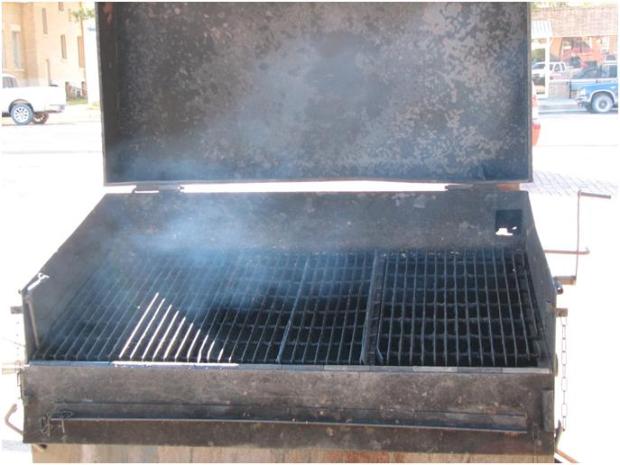
Here this bad boy is with the lid up:

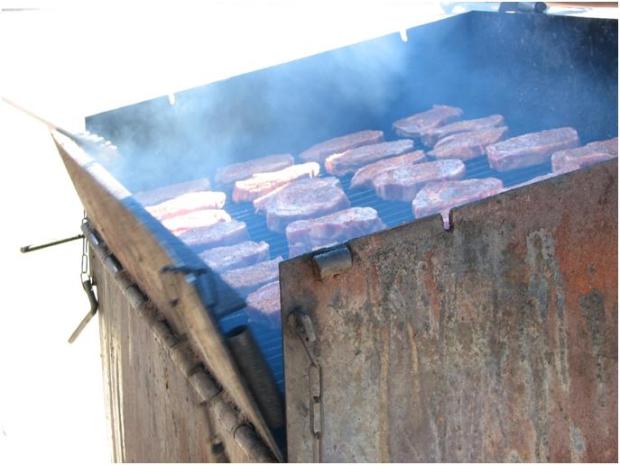
You’ll notice that the grill grates are on a slant. That’s key for a steak cooking pit so you can adjust the amount of heat on the meat. Steaks with less marbled fat are going to cook much faster than the ones that have tons of flavorful fat, so you want to put them in a cooler spot on the grill or pull them earlier. Also, notice the lip that folds over in the front. That has two functions: first of all, it allows for easy access to the cooking surface as well as for moving the grills to an angle. See the bar on the inside of the lip? You can put the grates on that for an even cooking surface when you are doing things like sausage. The other function it has is that it can be propped up from underneath so you can use it as a flat working surface for your tools or bins holding the meat you are putting on the grill.

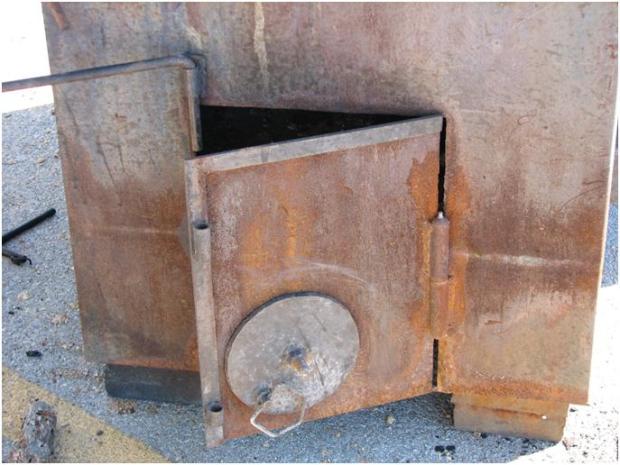
The firebox has two entrances in for proper flow, and you can adjust the flow in on both sides. There is a chimney on the back side of the lid, but BtC admits that the design is somewhat flawed. Moreover, the chimney just acts as a stop for the lid so it doesn’t flop all the way back.

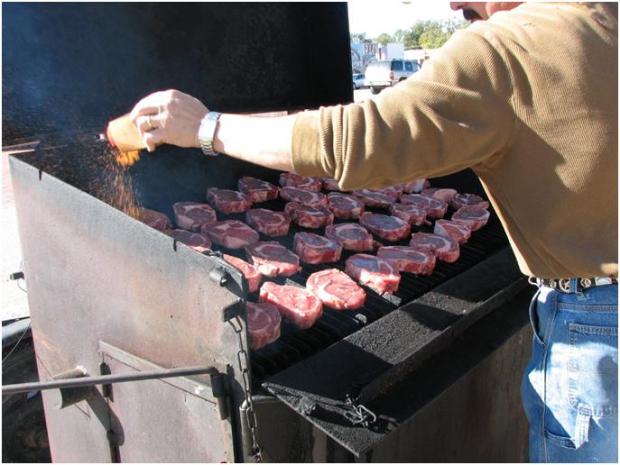
You can see how easy it is to get to the working surface from here. BtC puts the beef onto the grates before he seasons them so that the meat warms up and absorbs the seasoning all at once. Also, he keeps the meat that will cook faster on one side so he can properly tell how well done the meat is. The fire is well enough away from the meat so you don’t have crispy char on the steaks.

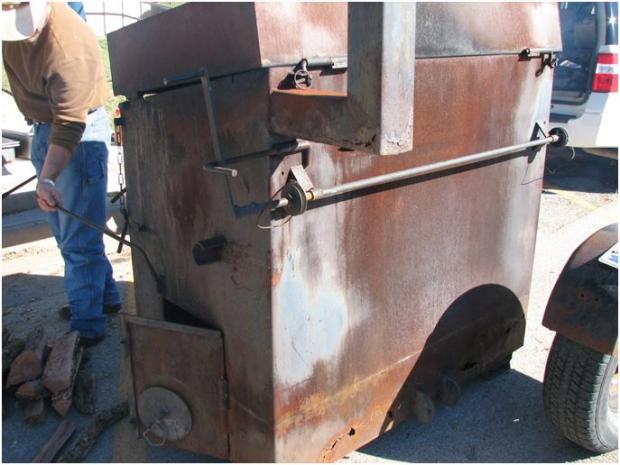
You can see from the backside that there was a pulley system at one time to raise and lower the fireplate, but years of use and weather rusted out the bottom. BtC had to have an additional plate welding in recently for repair, so the pulley system is non-functional now.

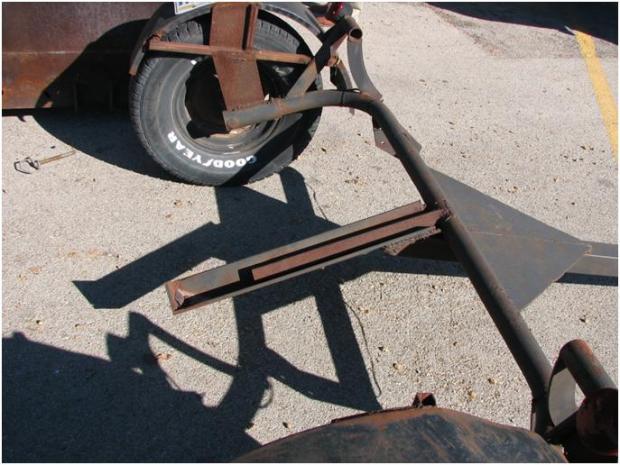
This is BtC’s trailer, specifically built for the cooker. He can haul and move this all by himself, which is remarkable because the cooker itself weighs hundreds of pounds. He took an old axle from a junk pile and made a long tongue on it for counterweight. Then, he welded a stinger that pins onto the cooker itself.

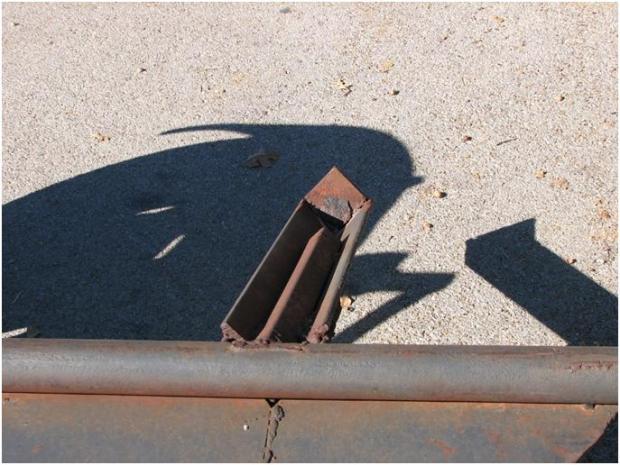
Right by the door on the side cooker, you’ll see a halfpipe. Also, on the trailer you’ll see bars that go across. BtC engineered this so the bars on the trailer go into the halfpipes on the cooker as a latch. With the trailer tongue up in the air, he latches the pin in place on the stinger and can pull the tongue down and attach it to his truck. The tongue is counterweighted perfectly so you have a zero balance right on the axle.

Using rebar and pipe, he engineered a hinge system as well as a poking bar all in one. You can see the bar there…he’ll use that to close the doors on the fire box as well as to reach up with the hook to pull the lid down during the cooking.

Secure pins are chained to the side so you don’t lose them. This is a great shot of that lip in the front.

There you have it…a Texas steak pit, fully mobile and as efficient as you can get for outdoor cooking.

The Smoker Project – Rehabilitating a Backyard Cooker

When you decide that you want to get into cooking as more than just sustenance and more of a hobby, one of the things you have to do is evaluate your gear. You don’t have to have the best gear and you may not have the money to spend on the most expensive equipment, but you need to have the right tools for the job. One of the things I love to do most is to smoke on a good smoker. The flavor of smoke combined with the caramelized flavors from your rubs and the “bark” of the meat is an art. Competitions around the country for smoked meats begin and end with the competitors trying to outdo each other on their rigs, and quite often they rip ideas off from each other to make the most complete cooker possible.

The question I get most from my friends who I cook for and are interested in getting into the hobby is, “What kind of ____ should I get?” People will try to skip a few steps in the learning process and go straight to overbuying for their skill of cooking. You have to spend time learning how things are cooked to really understand what kind of gear to get, although you never want to go with the cheapest thing you can find.

It’s like playing guitar. Sure, you can go out and buy the most expensive guitar you can find, but you won’t really appreciate it if you have no idea how to play a guitar. Most teachers will tell you to get as much as you can afford when you are starting out, then upgrade as you begin to know the difference. Always try different pieces, but most important is to get as good as you can get on your own, then try out other people’s instruments when you can and figure out what you like more/less about yours compared to theirs.

Now then…with all that out of the way, there is something that you should know: despite what hobby you are getting into, you should always try to minimize the amount of work you have to do in order to get the best results.  That goes double for cooking food.  Furthermore, if you don’t mind being a little bit creative and once you get your feet under you, then you should take the opportunity to use what you’ve learned and put it to practice. In regards to any smoker, these are the things you need to have as a constant:

-regulated temperature that’s not hard to control

-good airflow from intake (where the air comes in) thru flue/chimney (the “exhaust pipe”) and out the vent (where the smoke comes out)

-no flames directly on the meat

I don’t care how big or small your smoker is, if you don’t have those three things you won’t have a good experience. There are many other things you need to do, but those three are constants.

In regards to our backyard smoker project, we’ll keep those same things in mind. I had a smoker that was about five years old. I mainly kept it at my house for quick meals and I can use it as a pit because the firebox (where you build the fire) has an area for me to put a grill rack in for direct grilling. However, like any smoker off the rack, it’s not exactly built for heavy-duty use. After a few years, the paint was gone and rust sat in. Sometimes meals turned out good, sometimes they didn’t, mainly because it’s hard to control temperature on a smaller rig.  If you are handy with a welding rod, you can do some amazing things.  So, off to the Arcadian Ranch we go to do some metal fabrication.

This is what we are working with:

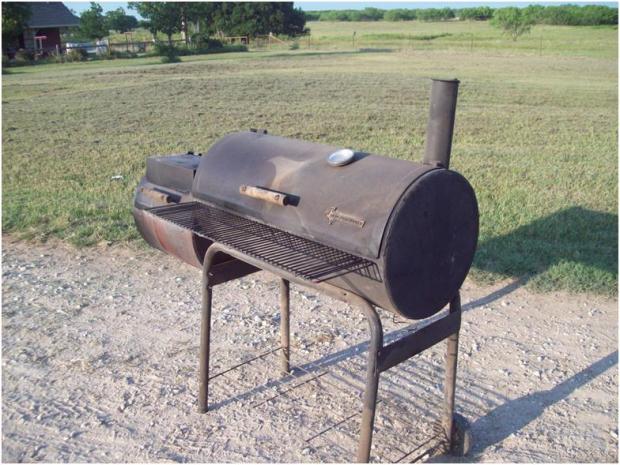
It’s just your standard smoker. This one is manufactured by a company called New Braunfels, and I think it came from Academy for $150. Nothing expensive…just a typical little smoker that definitely has its place in the world.  When you open it up:

You have decent access to the grill, which is actually pretty good sized. You can put a whole brisket in there and probably a rack or two of ribs at one time. That’s crowding it, though because:

The hole that goes to the firebox lends itself to direct flames on the meat. Direct flames create carbon, which is NOT GOOD TO EAT. A closer look at the firebox and the hole that goes to the smoking chamber (where you put the meat) shows the inefficiency of the design:

I took one of the grill grates off so you can see. The hole is so big that once you get a fire going, there’s nothing to stop the fire from attacking your food. Also, note that ash and cinders that are picked up in the airflow will be carried directly into the smoking chamber without anything to slow it down. Ash on food is NOT GOOD TO EAT.

The firebox design is pretty good, all things considered. You have a hinged door, a nice long handle to move the smoker, and a way to control your airflow.

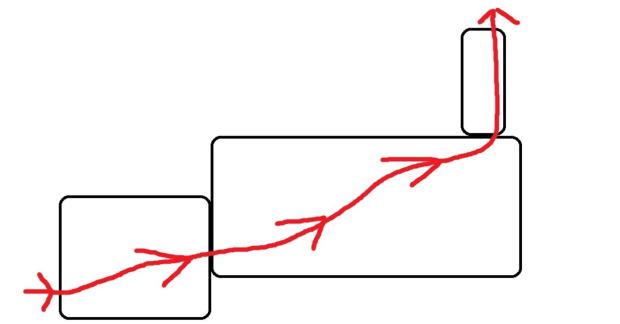
Speaking of airflow, let’s go ahead and look at the basic design flaws that we are trying to remedy. First of all, airflow is key when you are trying to smoke. One of the basic principles that people fail to learn early on when taking on the hobby is how to make the damn thing work. You have to open up the vent (where the smoke comes out) and adjust the intake (where the air goes in) to regulate the temperature. Never, ever, evereverevereverevereverEVER close down the vent on the top. Creating an area that has stagnant airflow will result in building up a creosote, and creosote is NOT GOOD TO EAT. This particular smoker is originally designed so the air flows like this:

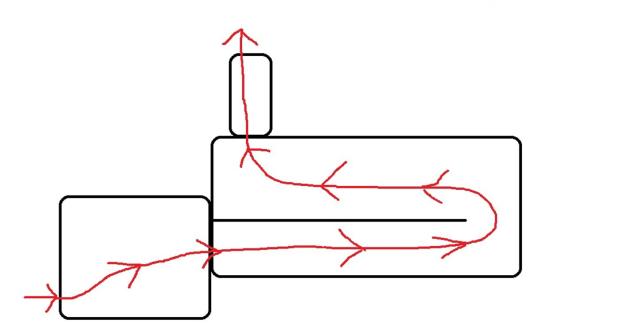
That’s a great design if you want to be able to get this thing fire engine red and cook the ever living shit out of anything within about a five foot radius. The suction from the intake is so strong you can actually feel it if you put your hand down there. As well, the air almost feels like it’s being propelled by a fan coming out of the vent. That’s just not what we are looking for if we want to keep our temp around 225-250® for 6-20 hours at a time. What we want to do is keep the good airflow but minimize the exposure to flame. To do this, we are going to need to put a plate inside the smoking chamber right under the grills over that giant hole. We want the airflow to be more like this:

This will:

-allow us to keep the temperature down (much lower than before)

-keep good airflow to reduce the risk of creosote

-eliminate the food in the smoking chamber from direct flames

Boom. That’s our design. It’s the design that any smoker should have. You can add on modular pieces, like a warming box or even another stack so that it’s easier to get the fire started to begin with, but we want the smoke to travel under the grill for heat and then across the meat for flavor and then out as soon as possible.

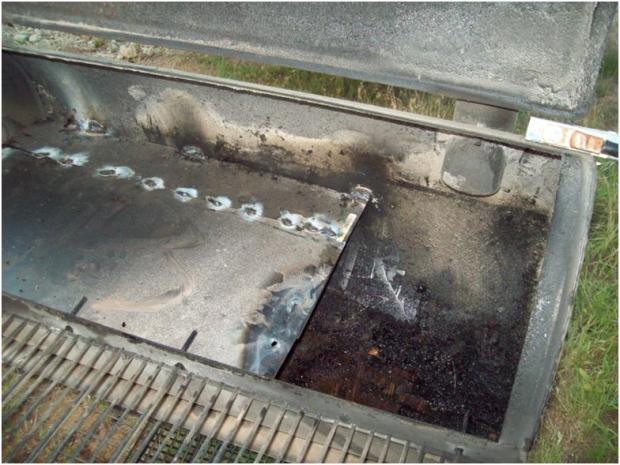
Let’s start with the plate running across the bottom. I didn’t take pictures of the welding itself, but you could imagine how hard it is to weld on thin metal that’s rusty, especially when you are welding it to brand new sheet metal. There are actually two pieces of sheet metal here that we’ve overlapped for strength. By placing the sheets directly under the lip of the smoker, we’ll have built in stability. As well, we need to tack a few spots along the side to keep it up. You could put in a brace underneath for stability, but once the weld should hold them in place. There won’t be any weight on them other than the drippings from the meat.

As well, we need to put a level on the plate and make sure that it’s tilted down towards the hole where grease falls out. Otherwise, you’ll have excess buildup that could create a flame.

Once we get the first plate on, we’ll slide the other one on and attach it both to the smoker body itself as well as the first plate we put down.

It doesn’t have to be air tight, but it does need to direct the airflow down the chamber as well as keep flames from licking the bottom of the food.

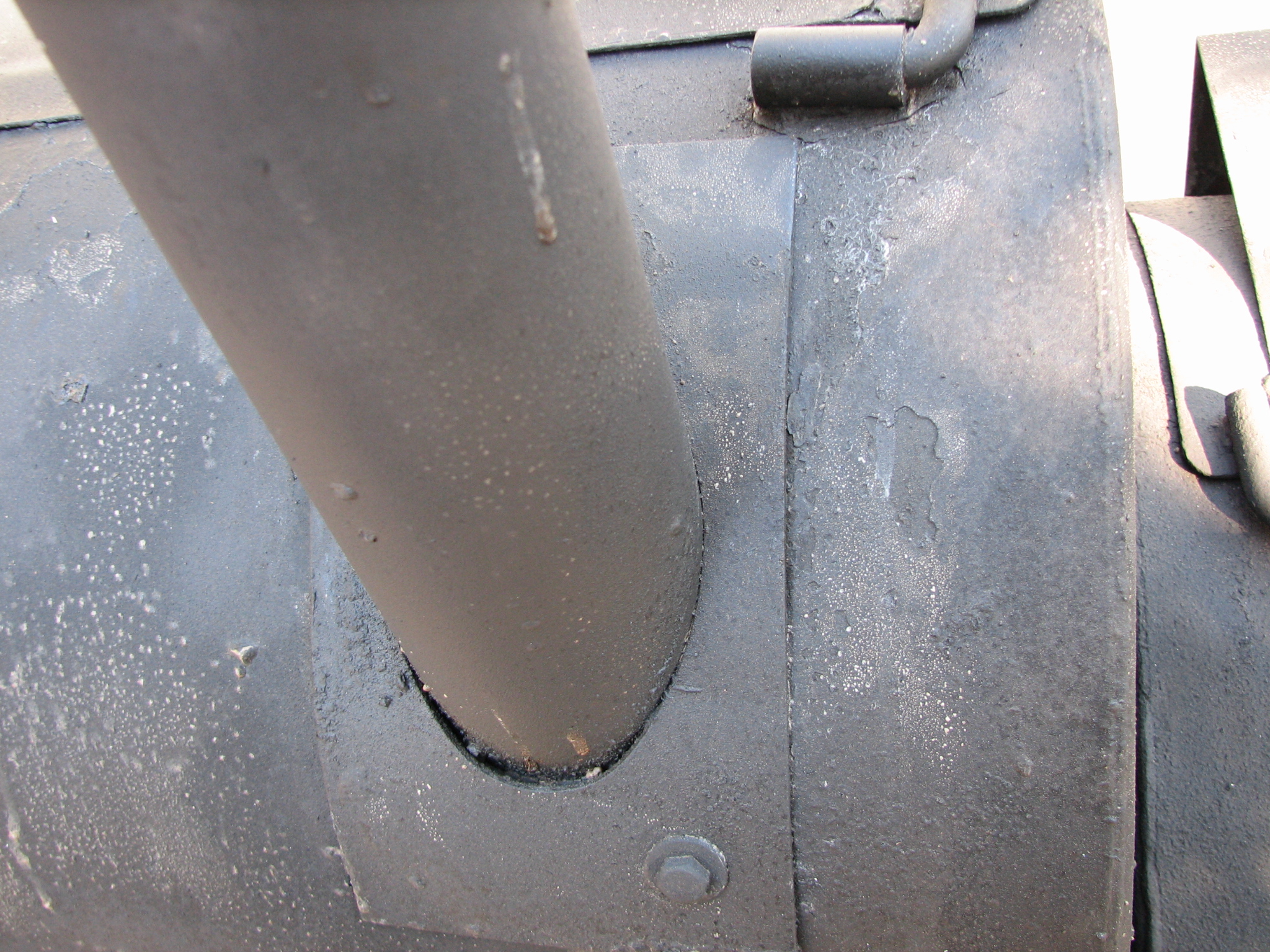
I have to move that chimney over to the other side of the smoker chamber. I stuck a piece of cardboard up to the hole from the inside and traced the hole with a pencil. Then, I cut the hole out and cut a hole into the chamber on the exact same spot on the opposite side of the back of the smoke chamber.

Now, I need to seal up the original chimeny hole.  I just took another piece of sheet metal and cut it into halves, putting one section on the outside and one on the inside, making sure they covered the hole completely.  Using the same bolt holes as before, I bolted the sheets on.

That creates the perfect path for smoke/air to flow so that I achieve my three constants of not being able to control my heat easily, not having stagnant air, and not having flame ups.  Once it’s all finished, I took a product called Ospho and coated the outside.  That kills the rust and it’s now ready for high heat paint.  (The two pictures above are post-Ospho)

After the paint cures for a couple of days, then go ahead and fire it up and get it hot.  With a spray bottle of oil, cover the outside and let it season.  Same on the inside…you need to spray it down when it’s hot with oil from time to time to make sure it keeps its season.  Once it’s seasoned, you can go ahead and cook on it.

There she is…my little backyard smoker.  I will add some other modifications down the road, like a more stable brace and bigger wheels, but as for now it’s ready and functional.  As they say in the Army and in prison:  smoke ’em if you got ’em.

Trav’s Corner: Blog Lasagna

11:30 Decide to make lasagna for dinner. Do a quick inventory and realize I no longer have a good pan for lasagna. This will need to be purchased. I can make the sauce now, but lunch first: pinto beans over spring greens with chopped roma tomatoes and hot sauce.

12:22 Assemble ingredients for sauce: 1 lb ground beef, 1 pkg Johnsonville Sweet Italian sausage (removed from casing), 1 onion (chopped), 8 cloves of garlic (peeled and chopped), dried basil, & oregano, ½ a bottle of 2003 Terrazas Malbec Reserva, V-8 low sodium, 1 regular size can of diced tomatoes, 4 large cans of crushed tomatoes. Grabbed a small stockpot.

12:29 Heated up pan over high heat with a little olive oil. Threw in ground beef and sausage. Stirred it around with a wooden spoon, breaking up meat until finely crumbled. Threw in 2 tbsp basil and one tbsp oregano. Let the water cook off, then stirred occasionally, letting the meat brown and caramelization develop on the bottom of the pan. Poured off some of the grease, and then threw in the onions. Sweated the onions some, threw in the garlic and stirred for about a minute. Poured in the red wine and brought to a boil while scraping the bottom of the pan with a spoon. Added about 1 ½ cups of V-8, brought back to a boil. Added all the tomatoes, brought back to a boil, tasted and added 1/2 cup of sugar. Covered and set aside to cool. Done at 1:10.

3:59 Purchased 9 x 11 Pyrex pan w/silicone lid. However, realizing that I have a lot of sauce, also purchase two “deep lasagna pan” foil containers. 

4:52 Begin assembly. Preheated oven to 350. In each pan, put the following layers, bottom to top: sauce, uncooked noodles (4 across, then one broken noodle going sideways (alternate sides of sideways noodle)), sauce, mozz, noodles, sauce, mozz, a 24 oz container of small curd cottage cheese mixed with an egg, noodles, sauce, mozz, noodles, sauce mozz. I regret not getting parm to mix with the mozz. I have to open a 26 oz can of Del Monte “Traditional” spaghetti sauce to finish the last layer and a half of the second lasagna. Covered with plastic wrap, then aluminum foil. Thought about how every time I tell someone about this, they ask “won’t it melt?” To which I have always bit my tongue and said “no, it won’t. Seriously.” Put the lasagnas in the oven at 5:27. Set timer for 1 hour and twenty minutes. 

6:47 Looked at lasagnas. Noting that there was no overspill from the pans, decided on another 15 minutes. 

7:01 Took off covers and set timer for 30 minutes. 

7:30 Took out of oven to rest and cool. 

7:40 Couldn’t wait any longer. Cut a piece. Mmm…


Texas Prairie Martini

There’s a part of me…a rather LARGE part of me…that loves a nice cold glass of liquor. The best alcoholics choose vodka as their boisson de choix, and who am I to argue with the experts?

There’s nothing like an ice-cold martini. Some prefer the Xmas tree lingering taste of gin, some like a little bit of vermouth; it all depends on the mood and most importantly depends on the drinker. That being said, there’s an equal if not greater part of me that’s North Texas white trash pedigree with a palatte for food that is hard to describe to most normal humans. We like our taco burgers, our Pittsburg Hot Links, and our pickled eggs. You put the two together and you have this incredibly dynamic mix of either delicious cocktail greatness or just a country washboard glass of goodness.

Up north of the Blackland Prairie where I grew up is the beautiful town of Muenster, Texas. If you want to throwback to the best of anything north of Dallas, you’ll find that this little town has it all. It’s a German town of about 1,500, and these people keep their town as clean as they can. There are two schools, one 2A school and one Catholic school (Sacred Heart ISD). The two schools are literally across the street from each other. Muenster hosts their annual Germanfest celebration, a half-concert/half-food festival in the last week of April every year. We don’t miss it in our family…I think we look forward to it more than we do Christmas. If you get a chance, you should make a day or even a weekend out of Germanfest in Muenster, Texas.

In downtown Muenster, there’s my favorite grocery store on the planet: Fischer’s Meat Market. Not only do they have a great selection of beer, wine, and Affiliated Foods groceries (the gears in any white trash family in north Texas), they have an incredible butcher counter (the back part of the store is also a slaughterhouse where you can take your beef to be dressed out), fresh German bakery items, and an entire row of canned/jarred food items that any north Texan would fall all over him/herself over. You can get apple butter, Hot N Spicy mustard, pecan pie in a jar, or any type of jelly you can think of including jalapeno jelly, muscadine jelly, or peach preserves. Right in the middle of this goodness is one of my favorite things in the world…pickled eggs. And not just any type of regular old pickled chicken egg; they have pickled quail eggs. This is the inspiration to this drink: leaning back on Lake Nocona on the Texas Prairie and sucking one of these down is as close to nirvana as possible (without the heroin).

First of all, to make a proper martini, you’ve got to chill the glass. Fill a martini glass with ice and then water and let it sit for a few minutes.


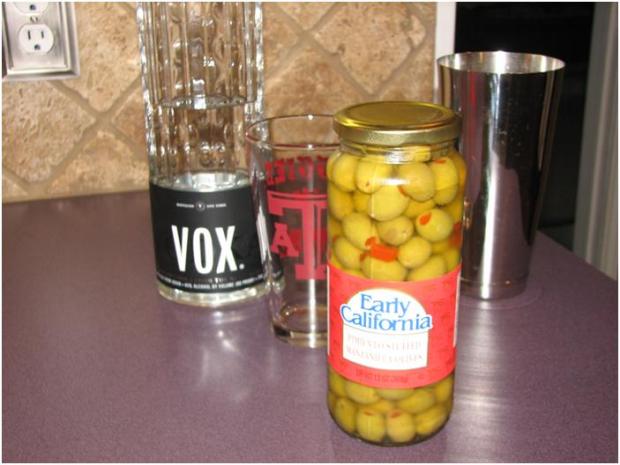
In the meantime, let’s review the ingredients list:

In that Aggie pub glass, we’re gonna throw in a few cubes of ice, three fingers of vodka, and another finger of the olive juice. That’s a pretty dirty martini…you can cut down on the olive juice if you prefer it to be sweeter and less olivey. What is a finger? Hold your finger up to the side of the glass and fill it up to the top of your finger. Then dump it all into the silver shaker, cap with the pub glass and shake three or four times to get it all mixed together. Dump out the ice water in the martini glass and clean out the extra water. Strain the vodka into the glass.  If it’s short, pour a bit more vodka into the glass, but don’t worry about stirring…that will come later.

Now comes the fun part. At Central Market, you can find a white cheddar called Isle of Mull. It’s incredibly sharp, but absolutely delicious. Take a bamboo skewer and run a couple of pickled eggs onto it. Then break off a hunk of cheese, and then top it off with a single olive. Break off the extra part of the skewer, but leave just enough to be able to hang onto it. Holding the broken end of the skewer, swirl the cocktail swizzle around in the vodka a couple of times to mix in the extra vodka (if necessary) and then serve with it across the rim of the glass (so the cheese doesn’t fall apart).

Voila…a Texas Prairie Martini, the perfect white trash cocktail and an awesome way to enjoy your cold liquor.

Trav’s Corner: Speckled Trout Tacos

One of the great things about being a food junkie is you get to find other food junkies and learn how to really cook things right.  Our S. Texas buddy, Travis, is a REAL foodie; a bona fide professional chef who left the trade for a normal job.  We’ve invited him to share some of his favorites from time to time here on AE.

——————————————————————————————

My corner of Arcadia is on the beach at South Padre Island. We’ve got a little place on the bay in Port Isabel with a dock and we keep an underwater light there that comes on at night to attract speckled sea trout. Not only are these fun to catch, but they’re also real good eating. My 7 year old son likes to catch a couple every night. We keep them for trout tacos. Here’s how I do it.

First, you’ve got to filet the fish. Start by laying the fish on the cleaning station with his back towards you.


Lift up the side fin and position your filet knife right next to the fin with the back of the knife at a diagonal towards the head:


Cut straight down to the backbone, and then turn the knife so that it cuts along the backbone.

 It’ll be tough at first as you’ll have to cut through some ribs, but after you get through that, it’ll go real easy all the way to the tail. Some people like to leave a piece at the end attached to the tail to make it easier to skin, but I prefer to cut it all the way off. Next you’ll want to remove the ribs. Place your knife right along the rib line and cut down at an angle, following the rib bones.


To get the skin off, lay the filet flat against your cutting surface, skin side down. Holding your knife flat, start at the tail end and cut through a little piece of meat to the skin.


Hold onto this piece with one hand and move the knife back and forth with the other. Let the knife do the work. Don’t try to push the knife along, and don’t pull the skin. This takes practice, but you can just trim off any skin you miss. Now turn the fish over and repeat.

 After you wash them off, you’ve got two nice filets. The next step is seasoning. I could put together some bad ass blend, but Tony Chachere already did:


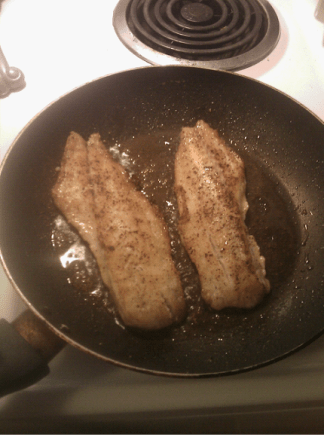
Sprinkle this stuff on liberally, and then the filets go into a hot nonstick pan with canola oil. Cook over high heat until browned and then turn over and do the other side:

Note: searing with Tony’s can result in some pretty caustic fumes. Make sure your vent hood is on (assuming it vents to the outside) or make sure your kitchen is well ventilated. Once the filets are browned on both sides, remove from the pan and place on a paper towel or rack to drain.

While they’re draining, heat a tortilla in a dry pan until warmed through. I like Mission multigrain tortillas with this for health reasons (and cause they’re really good), but you can use corn or flour or whatever.

Once you’ve got all the tortillas warmed up (two filets makes about 6 tacos) you can start assembly. Break off a piece of filet long enough to cover the tortilla lengthwise. Next, spoon on some Greek yogurt:


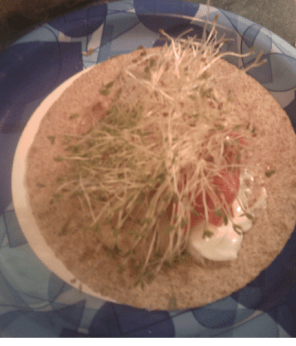
This is some good stuff, and you can use it like sour cream. Next, squeeze some lime juice on there and start adding toppings. Here’s one with tomato, avocado and sprouts, but you can go with what you like here, including cabbage, peppers, onion, lettuce, cheese, cilantro, etc.


Now sprinkle on your favorite hot sauce and go to town. I usually serve with rice and beans.

Special note: you inland types can sub bass or catfish for the trout. Tilapia will do in a pinch. Just go with white fleshed fish and you should be fine.

Pulling Your Pork – The Essence of BBQ

I’m a Texan, and any good Texan loves BBQ. However, BBQ can be a tricky. You can’t just throw a slab of meat onto a grill and then slather it with sticky sweet sauce and expect to have good BBQ. BBQ needs LOOOOONG slow cooking with delicious smoke from well-seasoned wood. What that means is that you have to have a piece of meat that has lots of fat, so chicken breasts and backstrap are out. Those boys in Tennessee and South Carolina know this as a BBQ must.

Here in cattle country, we know that brisket is the key to a Texas BBQ. And if you’ve read the Big Red Ribs recipe, you know that if you are going with ribs they need to be pork ribs and not beef. However, Texans have a really bad habit of overlooking the greatness of the Boston Butt. It could be because it’s pork and not beef; it could be because it’s got a yankee name and the fact that yankees call a shoulder roast a “butt”. Let’s overlook the sins of our sisters from the North and look deeply into what could potentially change everything you’ve known about BBQ and become a staple in your stable.

They call this thing a pulled pork; if you go to a Hard Rock Café, you should find a dish called the Tennessee Pulled Pork or the “TPP” (‘If you’ve been to the HRC and you haven’t had the TPP, you haven’t been to the HRC’). Before they closed the HRC in Dallas, that was one of my favorite things to get. I actually had a kidney stone attack one time eating a TPP, but it’s so good I hung in there for the whole sandwich before heading to the emergency room. True story. On a toasted bun, this might turn into your favorite BBQ sandwich, and again…this is coming from a Texas Beef fan.

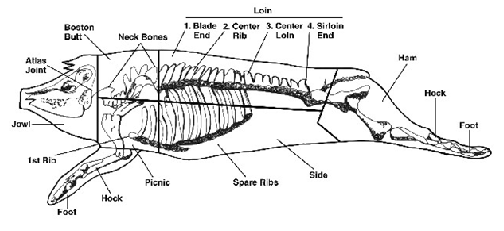
First of all, let’s take another look at our pig diagram:

Right above the ear, you’ll see the words “Boston Butt”. Yeah, it’s the shoulder. They also call this a “blade roast”. Either way, when you go shopping you’ll be looking for the biggest slab of non-ham pork you can find. Note: there’s also a “picnic roast”, which is a nice alternative if you can’t find a shoulder roast. However, the bone isn’t quite as easy to remove for presentation, so stick with the shoulder if you can.

In the package:

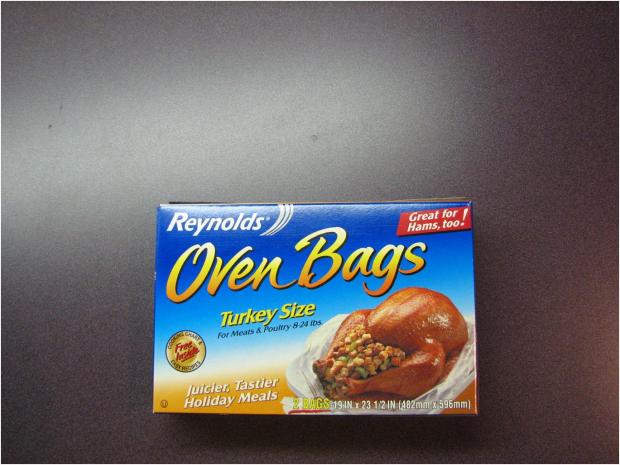
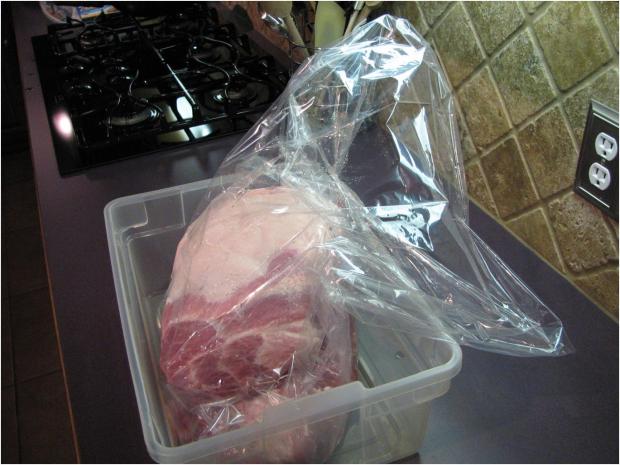
That’s an eight-pounder, which is about the average of what you’ll find. On occasion you’ll run across one a little bigger or smaller, but for the most part that’s what you’ll get when you buy one. First thing’s first….take it out of the package and rinse it under water. Be careful…there are a couple different muscles here, so it may try to fall apart on you. When you get it rinsed off and set aside, let’s get the bag out. I like to use a turkey bag. Reynold’s makes a perfect product for this:

Take the bag and put it into one of those cheap plastic storage bins.

I’m doing two roasts here, but you can double this up easily in the same bag and bucket.

Go ahead and put the roast(s) in the bag. Now, for the next 24 hours, we need to brine this bad boy. Remember…a brine is for moisture, not for flavor. If any flavor is garnered from the brine, it’s a bonus and not the original intent. The brine will be a mix of sugar, salt, and acid to break down those muscle fibers to be as tender and moist as possible. For our brine we are going to use about this much apple juice:

Just pour it right into the bag. No reason to scrimp, but no reason to over do it.

And about this much apple cider vinegar (about a cup):

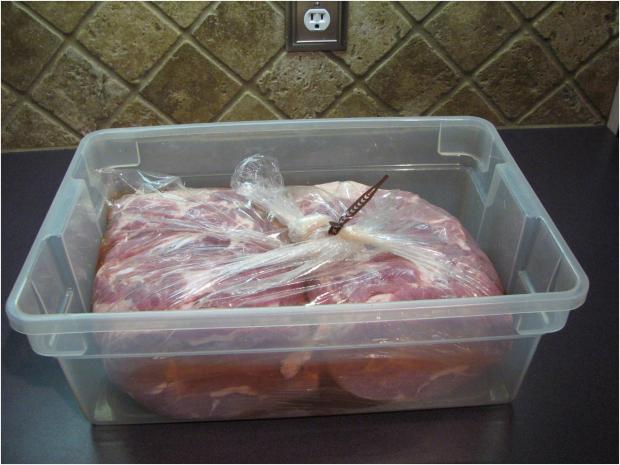
You can mix them right in together. Swish ’em around a bit, but you don’t have to worry about getting them perfectly mixed. Go ahead and close up the bag and get as much air as you can out. It’s not imperative to get it air tight, but it will keep your fridge from being too vinegared up if you get it closed.

Into the fridge it goes for the night. The next day, take it out of the fridge, unfastened the closure and pour as much of the liquid out as possible. We are going to use a dry rub on this, so you want to make sure you get as much liquid out as possible. No reason to save the brine…it’s done it’s job, and we’ll have ample liquid from the drippings from this after it’s cooked.

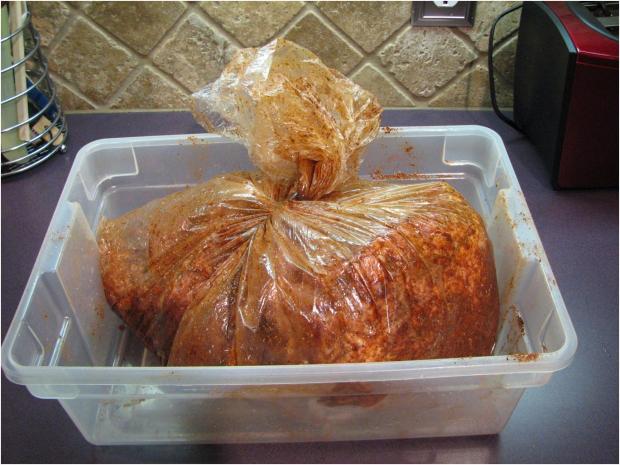
Using the Arcadian BBQ rub, liberally coat these things down on all sides and any cracks and crevices you can find. Then, put it back into the bag and close it back up. It needs another night to get seasoned up.

So that your timing is right, this is your timeline:

Day 1: brine in the evening, in the fridge overnight and into the next evening

Day 2: season with rub, into the fridge overnight

Day 3: smoking for six-ten hours (including the rest)

Fire up your smoker. Now, you guys know how I feel about mesquite. That’s not changing. However, I really like pecan/hickory on this recipe. Because you are cooking for so long, though, you’ll want to use a mixture. Mesquite is a harder wood and will cook hotter and longer than pecan, which is a softer wood. That’s why my nickname in college was “Mesquite”. What’s up, ladies?

Get your smoker rolling to 225-250deg and put your roast on fat side UP. It’s totally up to you on how much smoke you put on it, but you need at least 2 hours of pure unadulterated smoke. Some might argue with me on the fat thing, but if your smoker is designed correctly you’ll have indirect heat, full smoke, and the fat will melt into the meat fibers. That’s important in this dish. You see, it’s different from brisket because on brisket we cut against the grain. However, with TPP we are going to literally pull the pork apart so the meat fibers will be long. Since they are going to be long and not short, they need to have a lot of fat in between them to lubricate the fibers and make them easy to masticate. Get your mind out of the gutter.

After you’ve put all the smoke you want on it, take your digital probe thermometer and stick it into the opposite end of the shoulder blade bone longways and push it in as far as it will go. Then wrap the roast in foil VERY well. That is, lay down the foil with the shiny side down and lay the roast on it.

Then wrap the foil around the sides and back over the roast, making sure the thermometer is sticking out and the foil is tight around it. Then put another layer of foil around it. The reason is that there will be lots and lots of tasty liquid that we want to save, and if you don’t have it wrapped well the drippings will escape.

Note: the temperature we are looking for does not reflect doneness in any way. Instead, it’s just a marker for us to go off of because once we get to 195deg internal temp, then we know that the roast is cooked the proper amount of time to melt all that delicious fat intertwined into the roast meat fibers.

For the next few hours, keep your smoker going at 225-275. When you wrap the roast, it will probably be around 110-120deg. After you wrap it, the temp will start coming up relatively more rapidly.

Don’t rush it. We need it to go slow, so take your time and pay attention to the temp of the smoker and look for 195deg on internal temp. Once you get there, pull it and put it into a cooler. You know the drill…you need at least two hours of rest in the cooler, but the mass of this thing will let you go much longer. You can keep the probe in and keep the therm on and watch the temp. As long as you don’t drop too far down (130 or so), then you can let it rest a long time.

When you pull it out of the cooler, get one of those disposable foil pans. Get a deep one because the presentation is going to get kinda messy. Using your cooking gloves and with the assistance of your favorite sous chef, open up the foil and take the roast out without spilling any of the juice. The juice is good. The meat should be receded from the shoulder blade enough so you can grab onto it, give it a jiggle or two and take it out.

Jiggle to remove the bone

Throw it away…it’s duty to the world is over (or at least until some critty comes along to chew on it).

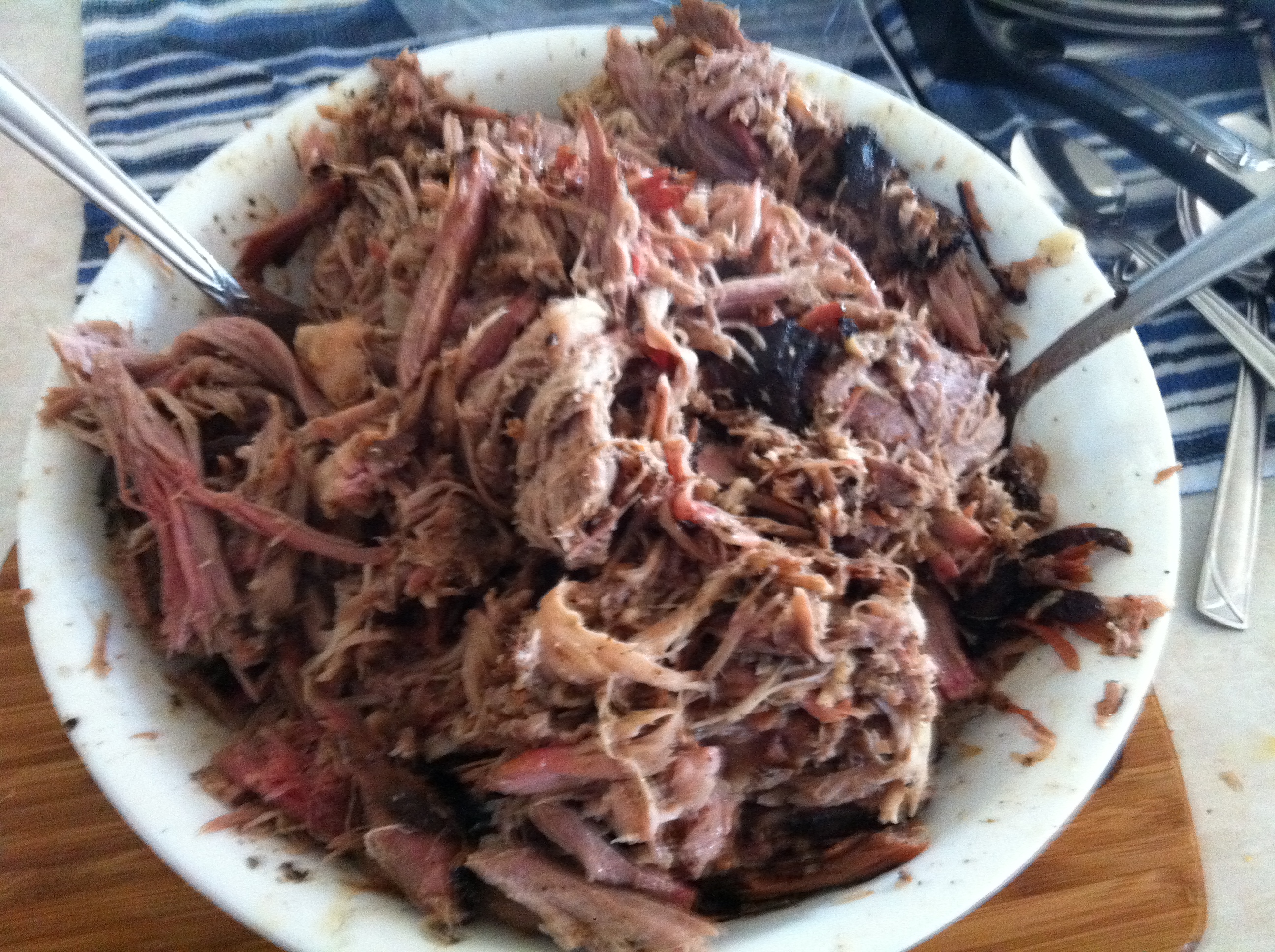
Using two large forks turned back-to-back, start ripping the meat apart. Don’t worry about being gentle, just rip. Break up all the chunks. It needs to be stringy.

When you get it all ripped apart, pour the juice over the top and toss the meat in it. Do as little or as much of the drippings as you want, but keep in mind that if you have any too much juice after serving the drippings will coagulate and make pork jello when it cools.

This is great straight up on a plate with some Texas Toast, or you can toast up some buns and throw some of the meat onto the crispy bun. Add some sauce if you like, a couple of pickles slices or onion slices, and you’ve got yourself a gen-yoo-wine TPP. Texas Pulled Pork, made the way Texans eat BBQ.