Pumpkin Pies – that taste good even though they aren’t perfect

I made this last week for the annual Thanksgiving family night dinner at my church. In preparation, I looked through several of my recipe books for a good one.

They all had the basic same ingredients except for one, which actually called for canned candied yams. Yep. Candied yams, which a good Ag woman knows that a yam is really just a sweet potato. Real Yams are imported from the Caribbean or Africa.

I’m a big fan of Cook’s Illustrated. It is by far one of the best producers of recipes in the U.S. They have new recipes but they also reexamine old favorites to get the best version of, say chocolate brownies. They definitely have a flog-it-to-death approach when it comes to research and trials and tasting. These magazines and cookbooks aren’t cheap but they don’t have any paid-for promotions, product endorsements or advertising.

Cook's Illustrated rocks!

I was feeling very sassy and took their recipe and deviated from it. (This is a big-time no-no. Baking is a science but it’s also an art—so until you get a feel for what you are doing, stick with the recipe.)

Pumpkin pie ingredients.

2 C. cream (you can use half n half)

3 Large eggs + 2 egg yolks (you will need a total of 5 eggs)

1 tsp. Vanilla

1 Can or (15 oz pumpkin puree)

1 Can candied yams (15 oz.)

¾ C. sugar

¼ C. Maple syrup

2 tsp. Grated fresh ginger

½ tsp Ground cinnamon

¼ tsp Ground fresh nutmeg

1 tsp Salt (use table salt)

1 Pie crust (see Never Fail Pie Crust or you can use the refrigerated, pre-made dough)

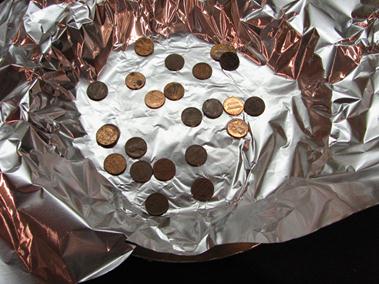
  1. You have to bake your crust a little before you put the filling in. Use pie weights or you can do what I did and line the pie crust with foil and throw a few pennies in as weights. Bake pie crust in 400 degree oven for 15 minutes. After the crust bakes for a 15 min, remove the foil and weights then place pie shell back in the oven to cook for 10 more minutes. Remove crust from oven when it just starts to brown.

    No pie weights, no problem. Lots of cookware is made from copper, so why no pie weights?.
  2. Whisk cream, vanilla, eggs and yolks and set aside. While your crust is baking, make the filling. Combine the pumpkin, yams, sugar, maple syrup, ginger, nutmeg, cinnamon and salt in a pot. Heat it until it gets to a sputtering simmer. Continue to let it simmer for 5 to 10 minutes. Mash it with a potato masher (or a fork). Stir constantly for another 5-10 minutes.
    Pumpkin, yams (aka sweet potatoes), sugar, syrup, spices.
    Keep stirring until it's done. It will get all creamy, sticky and thick.

  3. Remove from heat and let mixture cool for 5 minutes. Then add the cream mixture and whisk together.
    Let it cool before you add the cream and egg mixture. You don't want eggs to scramble.
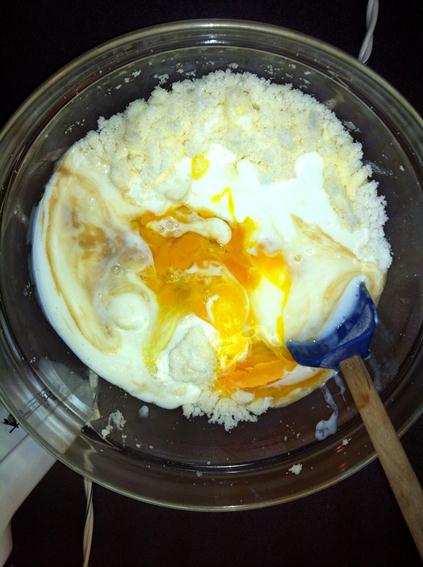
    Whisk together cream mixture and pumpkin mixture.

  4. Strain mixture thru a fine mesh strainer. Use a rubber spatula to push solids through to make a smooth, creaming liquid. When all the solids thru you can, give it one more stir then pour into the pie shell.

    Mr. Potato head helped me strain the solids thru a sieve.
  5. Pour into the warm pie crust. Place in the hot oven (400 degrees) and bake for 10 minutes. Turn the oven down to 300 degrees and finish baking for 25 to 30 more minutes. When the center is set (or the instant thermometer reads 175 degrees), remove from oven and let cool at room temperature for 2-3 hours until custard set.
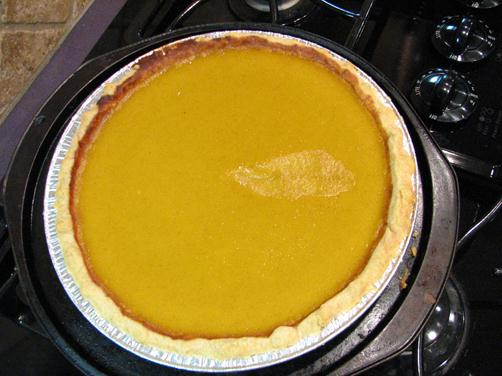
Nearly perfect pumpkin pie -- just put a dollop of whipped cream on that little hickey.

Tah-dah … And there you have a pumpkin pie that tastes good even though it’s not perfect.

Fall Color in North Texas

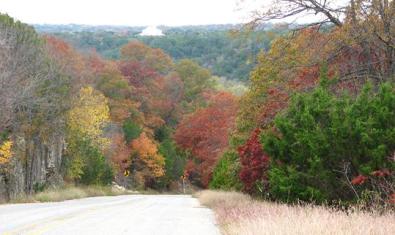
We spent Saturday night in Fort Worth this weekend. We had a blast with good friends, sampling wine, eating delicious food. But on our way to and from the big city we got to see a lot of beautiful fall colors.

Rock Creek Bridge.

I lived in Michigan for 6 fall seasons, with some of the most beautiful fall colors you can see anywhere. But it’s got nothing on Young County.

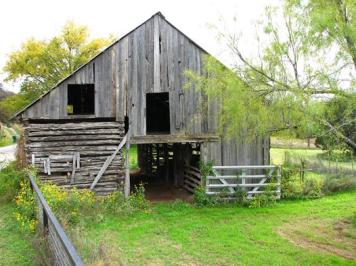
One-eyed barn.

This old barn looks like it’s winking at you. Not a lot of fall color around it but the picture was taken in the fall.  And it’s one of my favorites so I thought I’d add it in here.

In the Rock Creek area. Love the contrast of colors.

Now all we need is a strong, gusty wind to blow all the leaves off the trees.

Oak leaves.
I have no idea what kind of tree/shrub this is, but it's bright red. Awesome.
The hydro-electric plant. AKA "the Fairy Castle"

Of course the day couldn’t be complete without a beautiful sunset over the “fairy castle.” Thanking the trusty iPhone photography capabilities.

Buttermilk Pie

Buttermilk pie is a real winner at any function. It’s old-fashioned goodness. And it’s so easy and non-fussy, I’m almost ashamed to share the recipe, (almost, but not quite). This is easy to double too, then you can take two yummy pies to grandma’s for Thanksgiving. This is another recipe that is hard to mess up and very novice-baker friendly.

A buttermilk pie in all its glory!

Ingredients:

2 C. Sugar

½ C. Butter (one stick)

2 tbs Flour

1 C. Buttermilk

3 Eggs, beaten

1 tsp Vanilla

(One pie crust in a 9 inch pie pan/plate.)

Mix sugar and flour then beat in the butter.

Add the buttermilk …

then the eggs and vanilla and stir it all together.

Get out your wonderfully prepared pie crust (see Never Fail Pie Crust). If you’re in a bind, the refrigerated pie dough will work fine. Pillsbury is my favorite brand. Pour the sugary goodness in.

Bake at 350 degrees for about 1 hour or until your pie is GBD (Golden Brown Delicious).

This is actually a pumpkin pie, but the image makes me laugh with Elvis Parsley and Days of our Chives standing guard over the baking pie.

Never Fail Pie Crust

Literally a page from my grandmother's cookbook.

In 1975 my grandmother published a cookbook titled Food for Body and Soul. In it are some wonderful recipes that are passed down for generations. (more about my grandmother’s cookbook in another post).

The Never Fail Pie Crust is one of those great recipes. This crust is easy to handle and doesn’t require a lot of precision, like most baking does. It’s always soft, yet flaky. Because this recipe uses shortening instead of butter, it comes together very easily. It’s Never Fail, because anyone can pull this off, regardless if you’ve developed a “feel” for the dough.

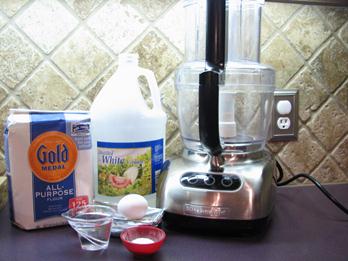
Pretty standard pantry ingredients for a pie crust.

Ingredients:

3 C. All-purpose flour

1 tsp salt (use table salt)

1 ¼ C. shortening

1 egg, well beaten

1 tbs vinegar

5 tbs water

All in.

Put them all into the food processor, and let it rip.

[If you don’t have a food processor, cut in the flour and shortening. Then add the wet ingredients.]

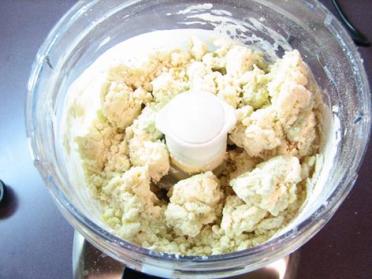
When it comes together in clumps, it’s ready.

Pretty much flour and lard.

Pull the dough out and shape into a ball. Cover with plastic wrap and refrigerate while you make your pie filling. This dough doesn’t need to be chilled necessarily, but it is easier to work with when it’s cold/cool.

Hanging out in the fridge, waiting its turn.

When you are ready for it, roll out dough on a lightly floured surface. This recipe makes enough for a double-crust, deep-dish pie or two single-crust pies. This can be rerolled without toughing and it keeps in the refrigerator for up to two weeks.

A beautiful pie crust.

Happy Pies, Y’all.


(buttermilk pie recipe coming next.)

Photographer in the Making

I came home tonight ready to write my blog post about pies and church suppers and small-town goodness. But when I opened up my camera’s files to see what photographs I had to work with, I got a surprise. (or maybe I should say gift.)

Apparently my son has been playing with momma’s camera.

Jdub’s babysitter, Flor, going down the stairs with coat hangers in hand. (Note blank wall where aquarium used to be).

Flor with coat hangers.

A picture of Jdub’s foot stepping down on the stairs. (This is a little unnerving for me, but I think it’s very metaphorical at the same time).

A blurry right foot. Better than a left foot, I guess.

A blurry photo of Flor putting something in the closet.

Action shot of Flor. I don't think she was expecting it.

Photo of wall and play closet. The walls are very blue – Jdub picked out the color himself.

Toys and stuff.

Photo of floor/rug in Jdub’s room, and the letters O, P and Q.

Hey man, nice rug.

He figured out how to flip open the flash … another photo of a right foot, and some trash. At least it’s in focus– progress.

More toes.

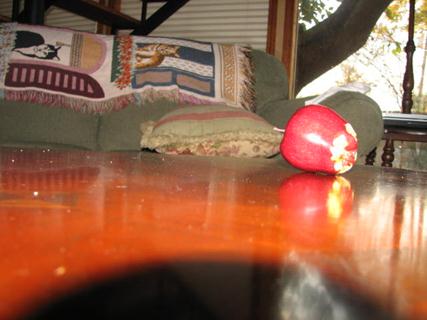
A picture of a partially eaten apple. There are about six just like this one—I think someone pressed the button over and over. We’ve made headway though—we are starting to experiment with composition.

Hopefully this wasn't meant for Snow White.

More experimentation with lighting and effects.

A study of light and shadow.

We’re taking risks here – experimenting with composition and perspective.

Apple in a different light.

An artist in the making …

Momma loves you, Jdub!

French Onion Soup

I remember the first time I had French Onion Soup. Actually, I don’t, but if you allow me to totally make up a story, it goes like this: I was hitchhiking across provincial France one summer when I was in college. After stopping in a small town for some bread and cheese, I noticed a wafting smell emanating from a cottage close to the marketplace area of the town. It was heavenly. It smelled like perfume…the perfect blend of peasantry and precision in food that carried me through the air like a Bugs Bunny cartoon where he gets the perfumed inner thigh smell of a carrot in his nostrils, which renders him helpless and catatonic as he slowly drifts thru the air towards the source of the smell.

I approached the cottage, knocked on the door, and was greeted by the most beautiful French woman you could imagine. She was fetching in the most humble ways…naturally beautiful, however she was reticent in seeing a stranger at her door who was sniffing the air like a bloodhound. In my broken French asked, “Qu’est-ce que c’est?”

Looking perplexed and glancing down at her feet, she said, “Ils sont mes chaussures.”

Actually, I think the first time I had French Onion Soup was at a Jason’s Deli or a La Madeleine or something like that. Either way, it left an impression on me.

Since I can’t recreate pastoral France nor is there a deli anywhere around me, I have to create my own FOS if I want some. Fortunately for me, my FOS is world’s beyond what you can normally find in a chain restaurant. Every young onion dreams of someday being the main ingredient in this powerhouse soup. So, without further adieu…he we goes.

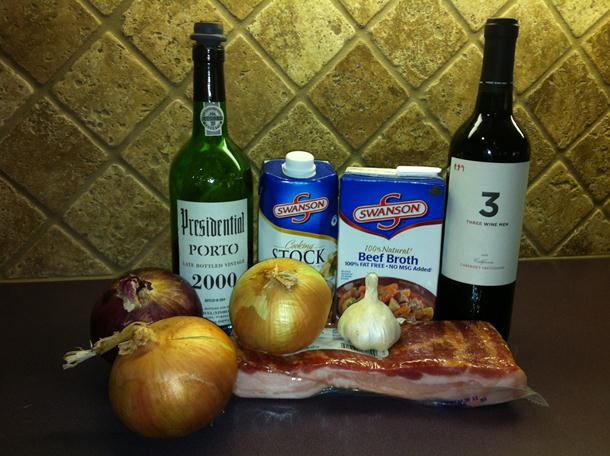
Mise en place:

-two large yellow onion

-one large red onion

-one large white onion

-3/4c of cabernet sauvignon

-1/4c of port

-6 strips of bacon

-4-5 cloves of garlic

-carton of beef broth

-carton of beef stock

-provolone cheese

-a nice french loaf

Boil some water in a large pot and add a bit of salt to soften the water.

Add the onions:

Blanche them for 2-3 minutes.

Then dump into an ice bath to stop the cooking.

This will make the skins easier to remove. You want to remove the outside layers that are papery. They’ll be quite toothsome in the soup, and you don’t want that.

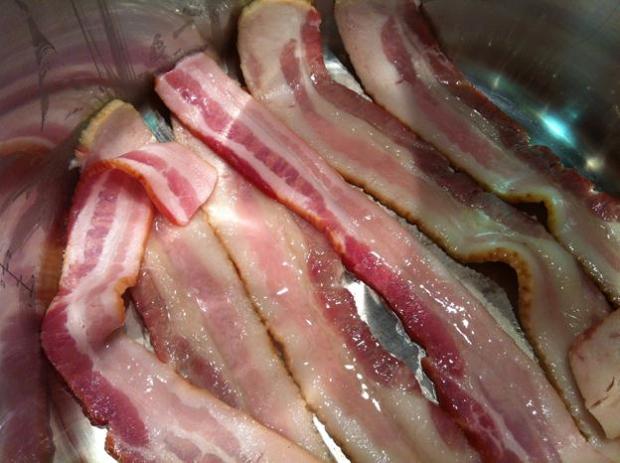
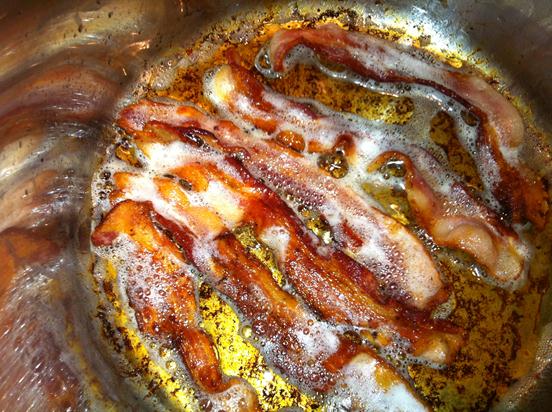
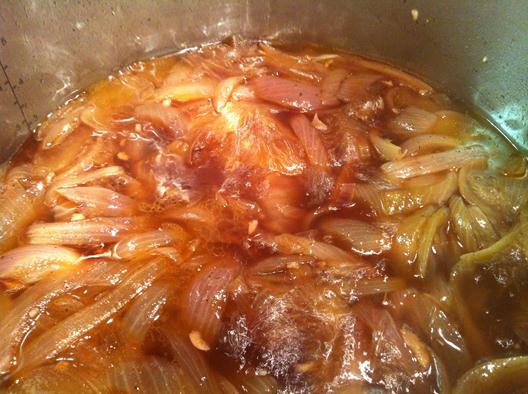
While they are cooling off, get your big stock pot out and render 6 strips of good bacon. Don’t cook on high…you need to be able to crisp the bacon up but not burn.

Remove the skins of the cooled onions.

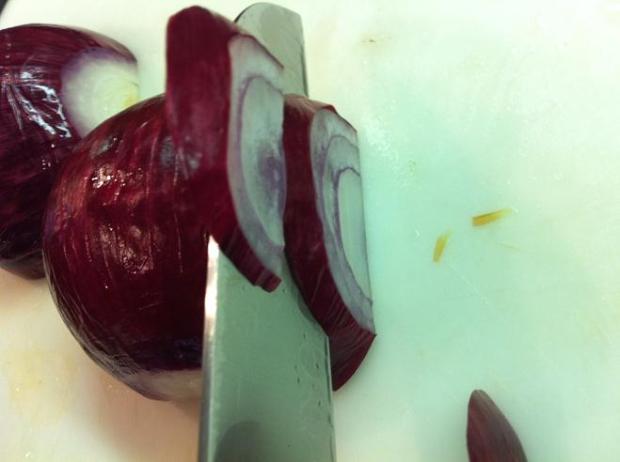
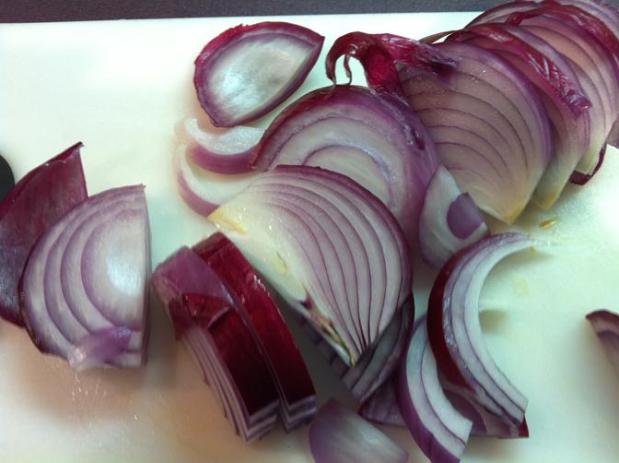
Half the onions, then julienne into strips. You want nice bite-sized strips. If you cut them too thin, they’ll disappear in the cooking. Make them too big, and they aren’t very fun to eat.

Do this will all the onions.

The red onions make a beautiful addition to the soup. They’ll leach that red color out into the soup.

Once the bacon is crispy and the fat is all cooked out, remove the bacon. Save it for a BLT or something. Don’t throw away good bacon.

Add all of the onion to the bacon fat.

Stir them so they are good and coated with the fat. Add some salt to make them start to cook down to translucent.

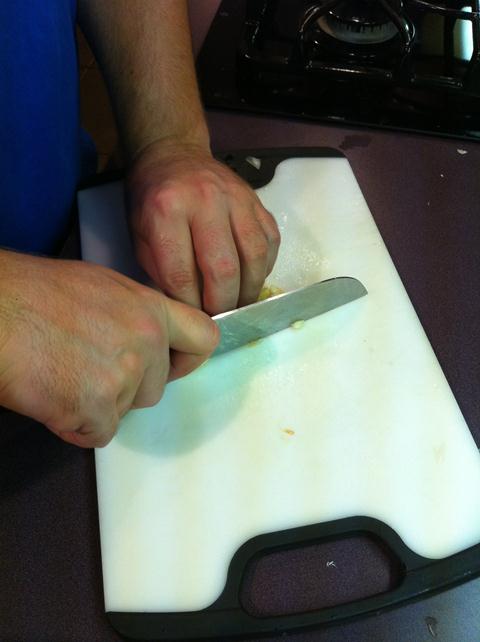
Five cloves of garlic, smashed and diced. I like to leave the garlic in small chunks so it has some texture to it in the soup.

Curl your fingers in and let the blade of the knife hit your knuckles. That way, you don’t get cut.

Add the garlic. More salt if you need.

Fresh ground pepper.

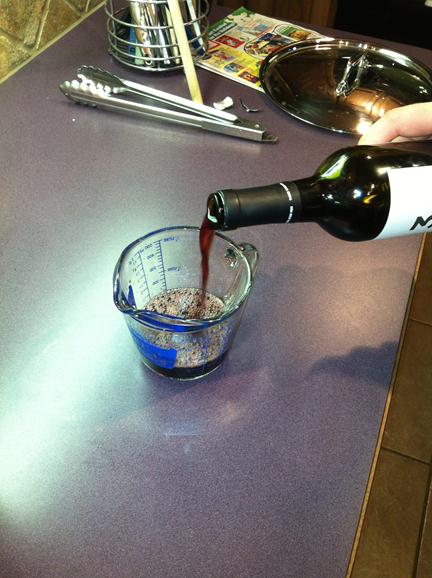
While the onions and garlic are cooking, measure out ¾c of red wine. I like using a tasty table wine that is good enough to drink along with the meal. The combo of the wine plus the soup is a great complement.

Plus 1/4c of your favorite port. I had an open bottle of vintage in my bar and needed to use it.

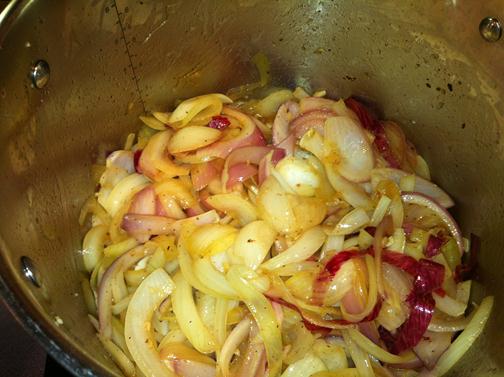
After a few minutes, the onion will start to become translucent so that you can see thru the edges.

Gorgeous.

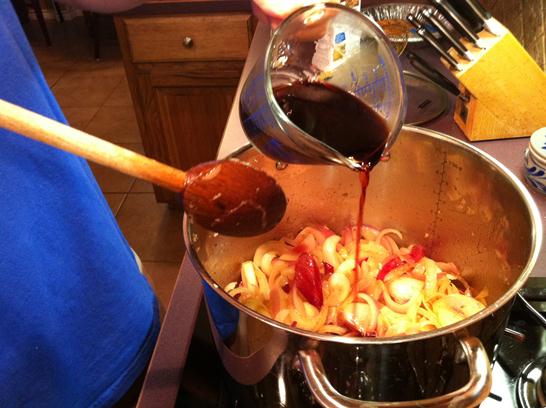
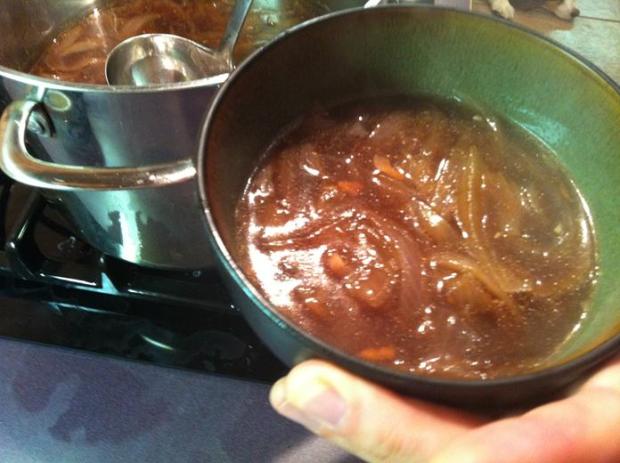
Add the wines to the onions. The wine will immediately lose its deep ruby color and turn kinda brown. We need it to mellow a bit before we add the stock/broth.

And a bit more salt. Taste this along the way. The salt helps drive the moisture out of the onion and make them soft.

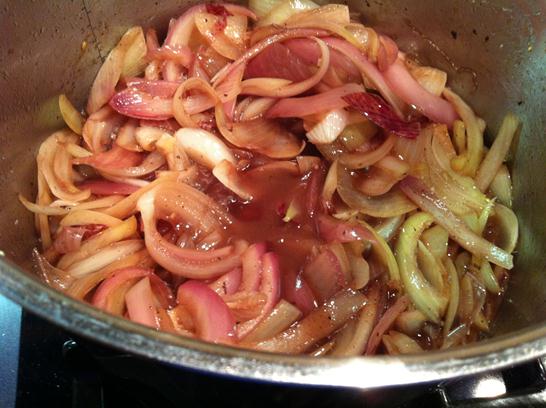
After a bit, the wine will mix with the moisture rendered from the onion and turn all of the onion a nice pink color.

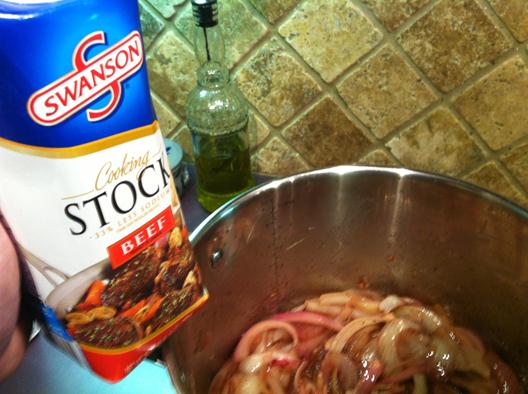
Now, since we are going to be serving red wine with this meal, I like to mix in beef stock and beef broth. Beef stock will have fat where the broth should be just about fat free. When you drink a red wine with big tannins, serve it with a fatty dish. The fat will coat the mouth and calm the tannins so that you can experience the fruit w/o drawing your mouth up.

Stock. In.

Broth. In.

Bring it up to a simmer, then cover and reduce the heat to a low simmer.

That needs to simmer on low for an hour and a half. At this point, salt and pepper to taste, but be careful. Over the next hour, the flavor is going to change drastically as all the flavors meld together. Now, notice that all we’ve added so far is salt and pepper for flavor. No herbs, no spices. That’s by design. The beef stock should be prepared with a bouquet garni for flavor. The natural flavor of the wine, the bacon, and the onion/garlic is going to be complex enough for us.

Taste it along the way. You’ll use more salt than you’d think, but be careful not to oversalt it. It’s best to get it to the point where you think it still needs just a bit more, then after the rest you’ll find that it’s perfect.

After an hour (notice the fat glistening on top):

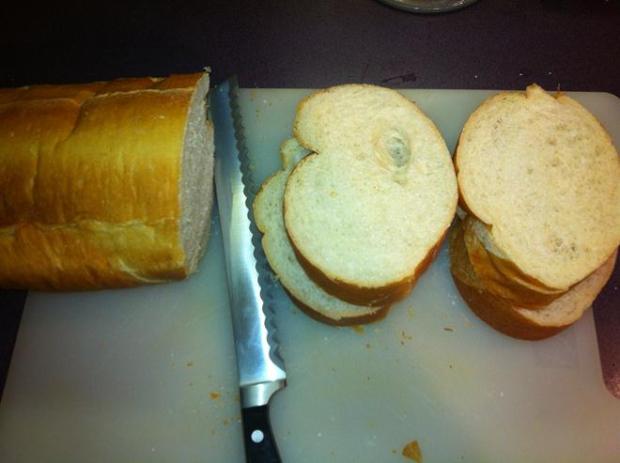
After the hour and a half long simmer, turn off the heat and let it rest uncovered. While it’s resting, cut a french loaf into 1″ slices.

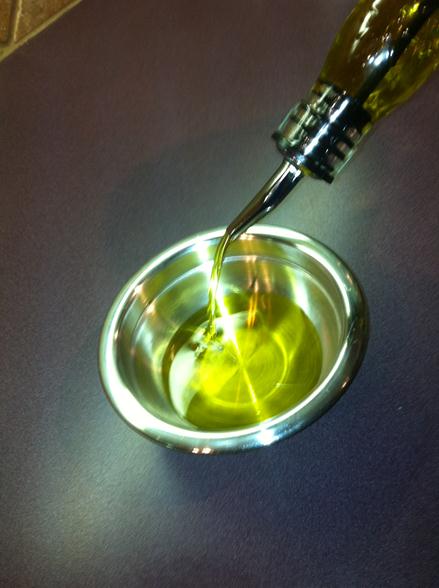
Olive oil.

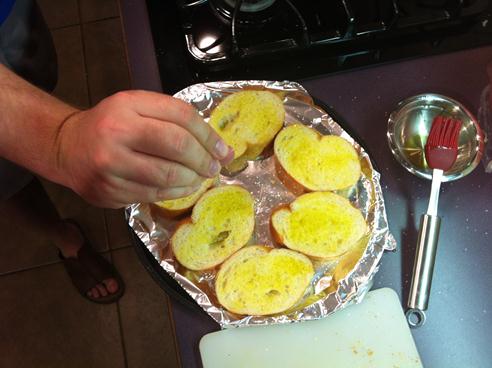
Brush the olive oil onto both sides of each slice of bread, then salt and pepper for each side.

Into a 425deg oven until nice and brown.

The crispy bread is integral to a FOS.

When the soup is finished, ladle portions into a high-sided bowl or a crock.

Put a crouton right in the middle of the bowl just on top of the soup. Don’t push it down…just float it right on top.

Take a slice or two of provolone cheese and lay it over the crouton.

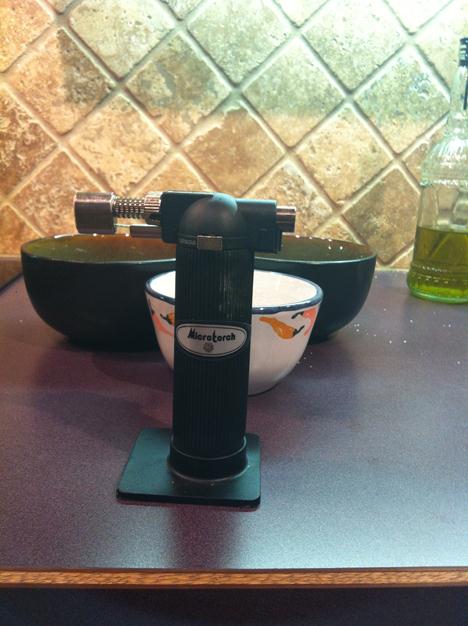
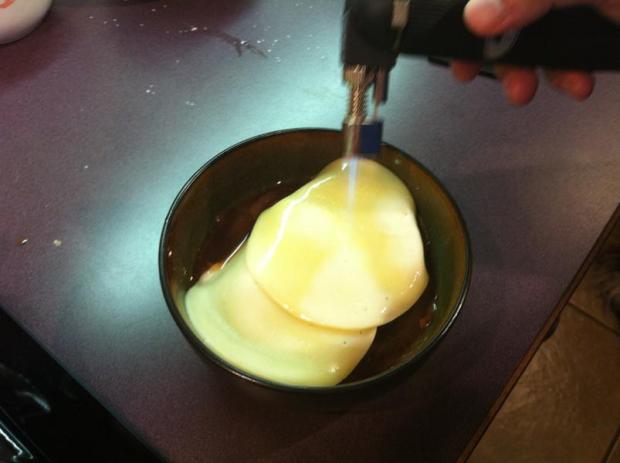
Now, some people like to turn their broiler on, slide the crock into the oven, and melt the cheese under the searing heat of the broiler. That’s a great way to do it. However, I like to use my kitchen torch to do it. I can be a bit more precise and get the cheese cooked to the perfect sear up close.

Seared:

Served with a bit of that tasty wine, and you’ve got yourself a delicious meal.

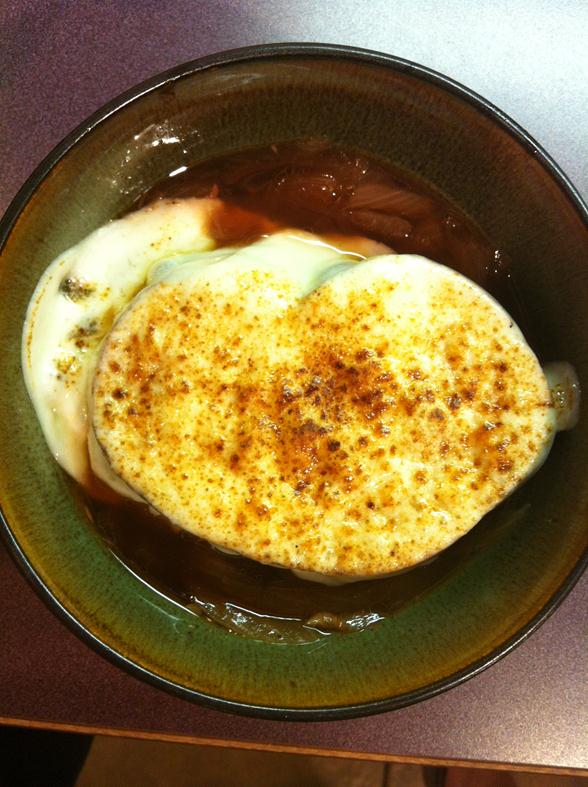
Here it is in its full glory. Bust thru the crouton that’s been soaking up that soup and spoon up the cheese with those onions.

And there you have it. French Onion Soup that will change your life.

When Frost Happens

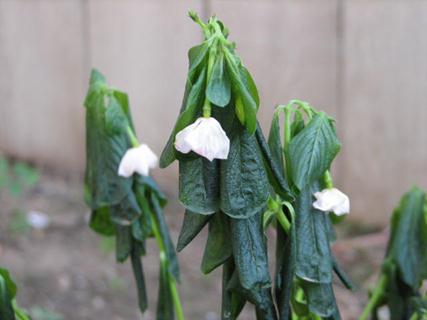
One and a half days ago the weather really changed when a powerful cold front move through. The temps dropped considerably in an 18 hour span. It went from being summer to fall in a few hours. There was nothing gradual about it. But then again this year has been anything but typical … 10 degrees in February then 100 degrees in April. Really!? Seriously!?

Yesterday… (OK, 1.5 days ago)

Today …

The first hard, killing frost happened close to dawn today – it was 25 degrees at 8:15 this morning. The frost twinkled brightly all over creation this morning.

At the stop sign near my kid’s school …

Sun on the left, frost on the right. Awesome display of the warmth of the sun.

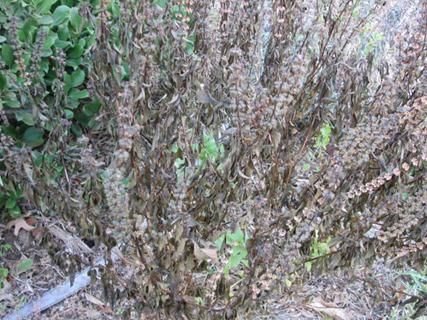
I attempted to cover my garden and a nice stand of Siam basil in my front flower bed. I had beautiful zinnias in orange and pink. Zinnias are a favorite of mine because they bloom constantly and do well in the hateful August sun plus they are drought tolerant. And we had a hell of a hot, dry summer this year.

When Frost Happens, Things Die.

Yesterday …

Today ….


The frost happened, and made this a very sad flower (and a dead flower.)

Frost killed this future eggplant.

Dead basil.

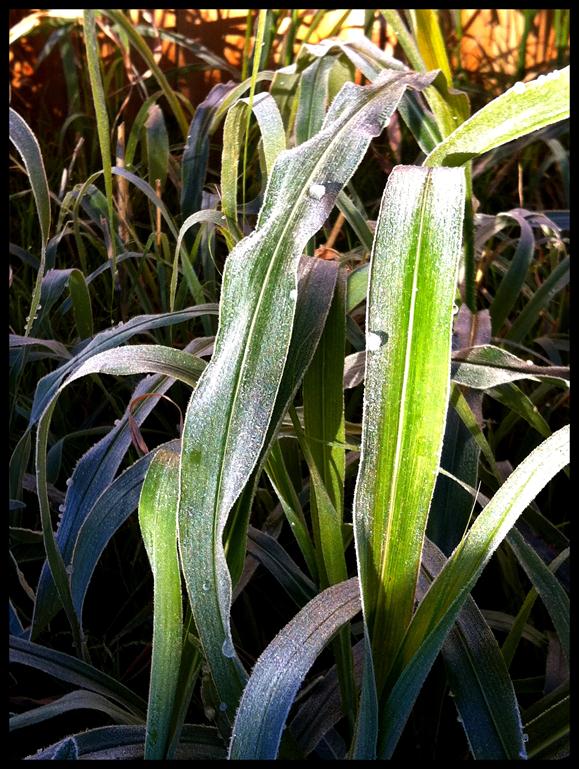
Although, the frost can bring about beauty of its own.

(How great is it to have a handy iPhone when you are driving down the alley and see something pretty?)

Welcome to the weekend, y’all!

Hometown Halloween

Halloween is one of those holidays that, as a kid, you look forward to all year long. I remember moving to a neighborhood after college and looking forward to greeting trick-or-treaters, only to find that there weren’t many kids around. And they didn’t go to a stranger’s house, even if it was next door.

Halloween moved into the category of a reason “to party” as an adult. Then I left the big city and traded my zero-lot line home for a traditional neighborhood in a small town. Now married with a kid, I live on a street where I know everyone’s name, and their dogs’ names too.

Halloween has once again become something magical and full of whimsy. All the things I remember as a child growing up in a small town. My son, John, was adamant about being Mario this year. (I’m glad we had Fox News on … that always indicates that my dad is at my house.)

Here in my little town they do it up right. There are car loads and trucks pulling trailers full of kids, decorations and an abundance of children weaving through streets and yards.

My son is trick-or-treating at the across-the-street neighbor’s house – he got homemade sugar cookies. That doesn’t happen in the city. People will think you are trying to poison their kids, even if they live across the street. These neighbors are also retired teachers that taught science and algebra to me.

And it’s on! We trick-or-treat on something I call the “miracle mile” also known as Rodgers Drive. We can walk up our alley, cut through a neighbor’s yard and walk a one-mile loop and get all the good loot.

It’s a gaggle of girls plotting their next Halloween maneuver.  How much you want to bet that this basic scene will occur many times in the years to come? I’m glad I have a boy.

There are multiple generations waiting on the door step to give out candy because there are so many kids …

Not the greatest photo, but you get the idea… there are quite literally thousands of kids that stream through this cool  neighborhood. (We actually don’t live in this neighborhood, but we’re in walking distance!)

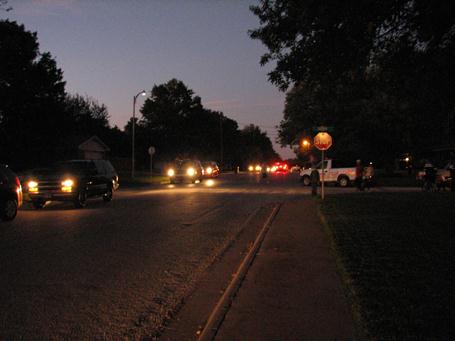
The intersection at Randy and Rodgers Drive … I wasn’t kidding when I said cars, trucks and trailers full of kids.

After our loop we end up back at our house and answer our own front door for the second wave of kids. Halloween is something of a marvel in our town. It really is something that looks like it was staged for a movie. By the way, we live in a place where we leave our kids outside to play in the street, which seems crazy in any place other than Arcadia.

Victual Files: La Taqueria Mexicana

If you like to visit different towns to take in and experience the local culture, there’s not a better way to do it than to test out the local food. A community is defined by what they eat and how they eat together. Especially in small towns, the available food is a large part of the definition of that community itself. Anytime we travel, we try to find out where the locals eat. You’ll usually get the best food, the best value, and the heart of what makes the community so much different than others.

The food culture in Texas follows no general rules, as each local town could best identify with BBQ or homestyle cuisine or even Mexican food. In the Old Town area of Graham is home to a non-so-hidden but probably mostly unknown treasure:  La Taqueria Mexicana.

Right on 4th street, residents have probably driven by it hundreds of times without much thought at all. Those who haven’t ventured in have really done themselves a disservice, though, because in the unassuming and relatively small taco shack you’ll find a delectable meal with “authentico” written all over it.

First of all, any Mexican food place that serves menudo on Sundays is as authentic as it gets. For those who aren’t familiar with menudo, it’s a stew that’s noted for its ability to help calm the aching head and rumbling gut of a late-night Saturday spent on the bottom side of a beer bottle. It’s not for the faint of heart, though. Menudo is a spicy broth made with chilis, tons of herbs and spices, and glistens with fat that’s rendered from its main ingredient: tripas, or tripe. Specifically, menudo is made with the honeycomb reticulum tripas from a beef’s second stomach. That’s right…one of the best hangover cures in Texas and all points south is a spicy beef stomach stew. Sounds disgusting, right? It’s definitely an acquired taste, but if you appreciate real Mexican cuisine and don’t pale at the sight of offal on your plate, then give menudo a try.

I’m not here today for the menudo at Taqueria Mexicana, though. It’s the tacos. If you like tacos (and every non-insane human loves tacos), then this is the place you need to head.

When you walk in the front door, you see the kitchen behind a front counter, and off to the right you have a small dining area.

Taqueria Mexicana has a solid reputation around town as a great place for breakfast burritos (which are more like the size of what we consider to be a taco). There’s nothing wrong at all with coming here for those, because they really are outstanding. Your choices for breakfast burritos include:

Pick either egg with meat or potato with meat. You can’t go wrong with these, although I’m a big fan of the potato with chorizo and egg. A closer look at the full menu:

This is the first page but you can see that you’ve got a pretty good choice of how you want your dish. I’m here for the taquitos, or little tacos. They are served on corn tortillas, which are made fresh back in the back. If you order the burrito, you get a flour tortilla, which is also made in the back. I love either one, and depending on my mood I’ll order either or both. Specifically, I’m here for the tacos al pastor.

Tacos al pastor are made with pork over a rotisserie. The meat is cooked similarly to the way that gyro meat in greek cuisine is made. The meat is cut into small bite-sized bits with just a perfect amount of chewiness and toothiness to make you want to take as many chews as possible to extract the most flavor.

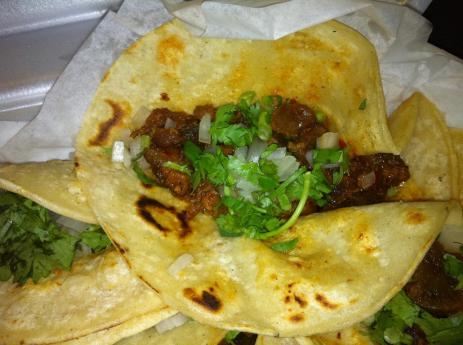
Fresh onion and cilantro highlight the spicy flavors on the tacos al pastor.

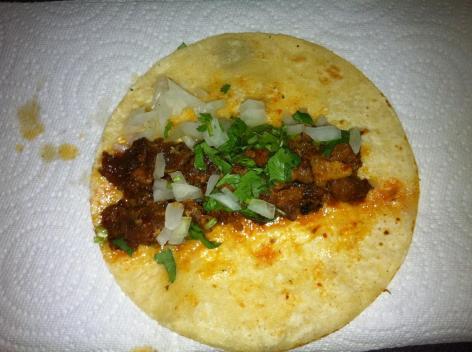
While I was there, I went ahead and picked up a handful of the brisket tacos, too. It’s a different flavor profile completely, but it’s a formidable back up to the tacos al pastor on the menu

A close-up of the tacos al pastor:

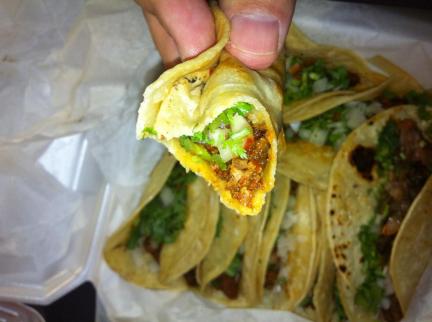
Roll this over so you have a tight cigar, and you have a compact blast of nuclear Mexican flavor. The soft chewiness of the meat, the crunchy fresh onion, and the perfume of the fresh cilantro is unbeatable.

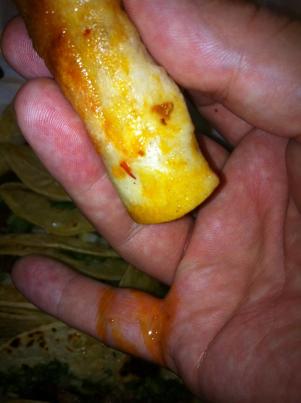
This is the part that I love…the mouth-coating grease from the pork falls right out the back. The seasonings, a mixture of chili, cumin, and oregano, make for a finger-licking cleanup.

Those brisket tacos I was talking about? They make a great mild compliment to the spicy pork.

Laying these out, you can see the perfect amount of meat, laid perfectly into the center of the taco.  No cheese, no sour cream, no ancillary or superfluous filling to take away or confuse the flavor.

Other menu items of note:

-The gorditas are incredible. They take the same meat as the tacos and put them in a purse of masa (like the texture of a tamale, but not steamed and round like a large ravioli).

-If you think you can handle it, try the chicharrones on your taco. Those are “pig rinds”, or pork skin cut into strips. The texture is like stiff gelatin.  Unless you’ve had them before and know you like them, go ahead and hold off on those until your third or fourth trip to TM.

-The salsa (labeled as “big container of hot sauce” on the menu) is superb. They serve a single serving with each taco/burrito, but you can also buy it in bulk. It’s fresh and delicious.

-You can buy the flour tortillas by the dozen. Homemade tortillas are unbeatable anyway, but the ones at Taqueria Mexicana really are tasty.

-During the week, they have lunch specials served with rice and beans.

Authentic. Homemade. Delicious. Taqueria Mexicana in Graham, Texas.

Dad’s Mustard Brisket

Of all the things I cook, the most requested recipe is brisket. As a Texan, it should be required in order to graduate high school to know how to properly cook a brisket. It doesn’t have to be smoked, but right before they hand you a diploma, if you can’t answer “slow and long” to the question of how a brisket should be cooked, they should send you back to class.

My brisket is a world-stopper. You’ve never had BBQ quite like this, and the key is yellow mustard. Not fancy brown or Dijon mustard, but plain ol’ French’s mustard. Here’s my secret, though: This isn’t my recipe. It’s my dad’s. When he first told me how he was doing his brisket, I just about squeezed my eyeballs out of my head squinting at him. Sure enough, though, he was right. He’s right about a lot of things that I challenge him on, but none moreso than mustard brisket. Here’s to you, dad.

I’ve never officially gone thru this procedure before because of one major component, and we might as well tackle it head-on right out of the chute. To properly cook a brisket, you’ve got to dedicate an entire day to doing it. Not a “day” as in “when the sun is up”, rather a full 24 hours. An entire rotation of the friggin Earth. If you aren’t willing to put in the time, sacrifice some sleep, and do this right then don’t bother with it. Go get yourself a nice margarita and rent Brokeback Mountain. When you get started on this, take notes of time and do it right. Don’t come bitching to me if you pull this thing after the sun goes down and it tastes like shit. Not my problem. You’ve been warned.

Your timeline is:

Day 1: Brine for 4-6 hours, up to overnight

Day 2: Marinate overnight

Day 3: Smoking

4-6 hours unwrapped

12-14 hours wrapped

4-7 hours in the cooler

Example:

1) Put the brisket on at noon unwrapped

2) Wrap it at 6pm

3) Put it in the cooler at 7am

4) Serve at noon.

24 hours.

Good so far?  Good.

Now that we have the unpleasantness of the requirements out of the way, let’s get to the basics of Texas BBQ beef. The brisket was just a trash piece of meat until just a few decades ago because no one knew how to cook it right. For reference, picture a delicious bovine:

The brisket is the cut just above the front legs. Think of it as your chest if you were to get down on all fours. Because of where it is, more than half of the entire body weight of the animal sits on this piece of meat. Therefore, it has to be strong, long meat fibers that are filled with fat and connective tissue. In addition, there are three different muscles that come in, and therefore three different meat fiber directions. This makes things really difficult to manage, especially when it comes to cutting the finished roast.

Ranchers would just toss this thing because it was so hard to cook. There’s an entire cap of fat on one side, and all three muscles are separated by  layers of fat and membranes that are really deep and hard to get to before it’s cooked. Even then, you can easily mess up the presentation by cutting it wrong. The direction of the cut is almost as important as how it’s cooked. About 50 years ago, though, ranchers started noticing that their Mexican hands were taking the briskets and making incredible dishes with them. They figured out that what they were doing was cooking it over low heat for a long time in a braise. They took the braised meat and cooked it over dry heat, and the modern Texas BBQ was born.

Now that I’ve officially scared hell out of you for cooking this thing, let’s get things prepped. We’ll need:

-an untrimmed brisket. UNTRIMMED by the butcher, that is. Don’t get a trimmed brisket.

-Bottle of Allegro marinade

-French’s yellow mustard (generic will do; I’m using French’s here so you see it’s not anything special)

-An oven bag

-Your favorite BBQ rub

That’s it. Not a whole bunch to this thing. Your brisket needs to be untrimmed. Competition BBQueers will try to tell you to trim a brisket, but that’s just because they are trying to skip on time. Keep it untrimmed…we are going to need as much fat as we can get. What size?  Hell, I don’t know.  About this big will do:

Doesn’t really matter. When you go to pick it out, what you are going to be looking for is a solid cap of fat on the backside of the brisket (they always put the label on the opposite side because it’s prettier). I had someone tell me one time that they went to Central Market and bought a “prime” brisket. I’m not sure that it even exists. This is meant for trashy cuts of beef, so the sinewy-est, fatty, marbled up slab of brisket you can find is perfect. If you spend more than $2.50/lbs for your brisket, you got taken. Look for it on sale, and buy it when it’s around $1/lbs and freeze it.

Take your brisket out of the plastic and rinse it under water to get off all the extra blood. Let’s examine:

You see the long meat fibers here? They lie just under that membrane on top of the meat. Don’t peel it off…I just want to point out how the meat runs for later. We are going to cut AGAINST the grain when we serve.

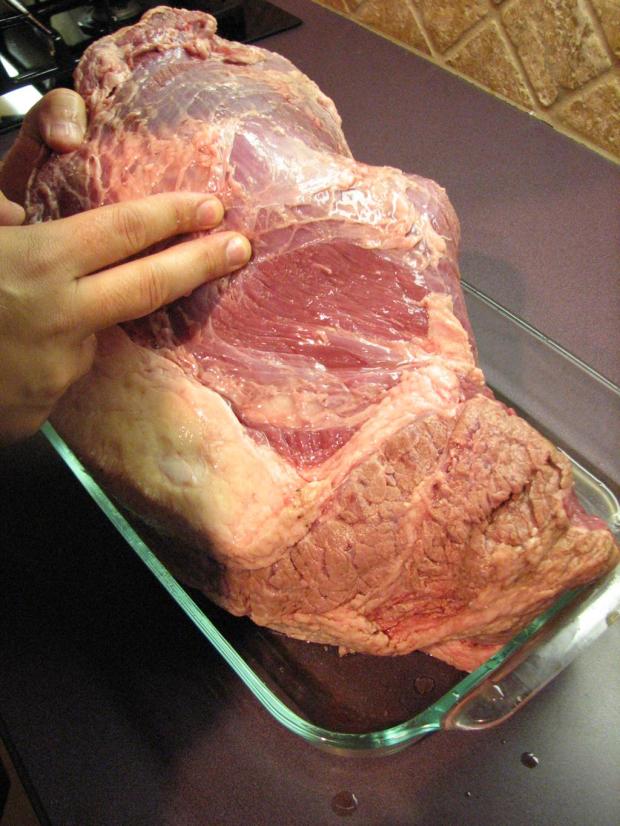
I pulled back that membrane a little bit to get a good shot. See how the direction of the fibers curves away? When we start cutting, we’ll need to look for that, and stop when we get to the point where we aren’t cutting against those grains.

The fat cap:

One of my favorite tools is the Reynolds turkey bag. They are just plastic bags that you can marinate/brine your meat in. Take one out, and put your brisket in, with the fat cap side DOWN.
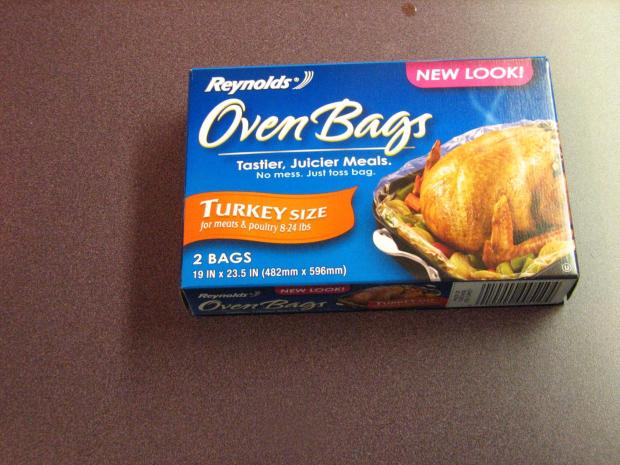
I like to put it into a pan in case there’s a leak in the bag, and there’s always a leak in the bag.

Now, take that Allegro marinade and pour in enough so that it comes up about halfway up the brisket.

Make sure that it’s the fat cap side that’s down, and not the meat fibers. What we are trying to do is use that salt and acid that’s in the Allegro to break down the fat and the muscle fibers around the fat. If you brine this with the meat side down, you are going to turn the meat into mush, and we don’t want that. Seal up the back and put into the fridge for 4-6 hours, up to overnight.
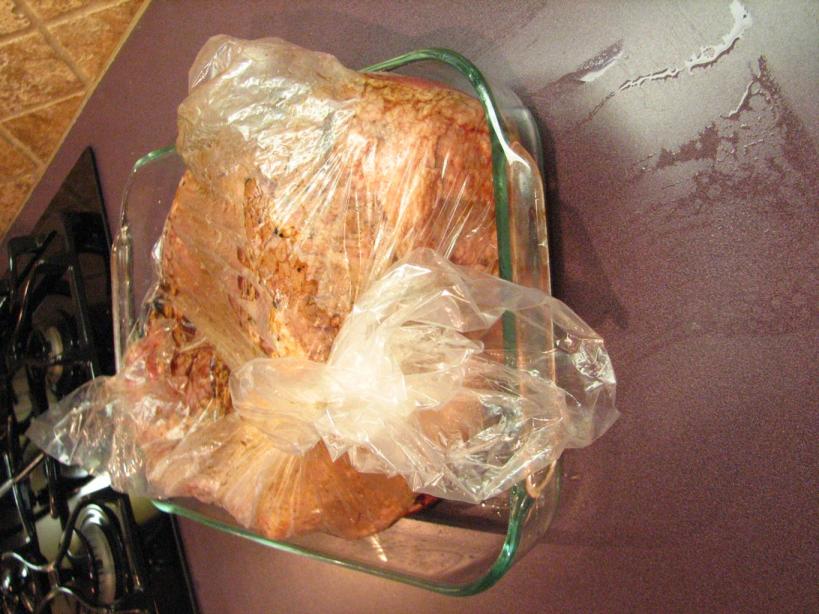
When you are finished, pull it out and lay it into a pan big enough to hold the whole thing. This is key…you are going to be flipping it in just a bit. Start with the fat cap side DOWN.

Get your yellow mustard out and squeeze LIBERALLY all over this thing, and then smear it with your hands so that it’s thick all the way around. Go ahead and rub it in kinda hard into the cracks and crevices where you can get your fingers. I always start mine out right:
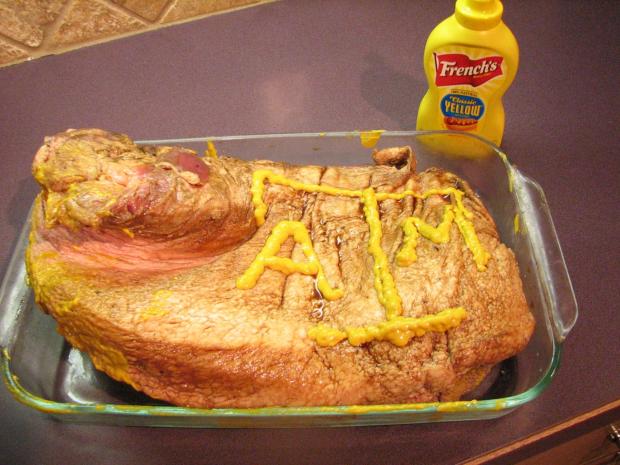
Coated:
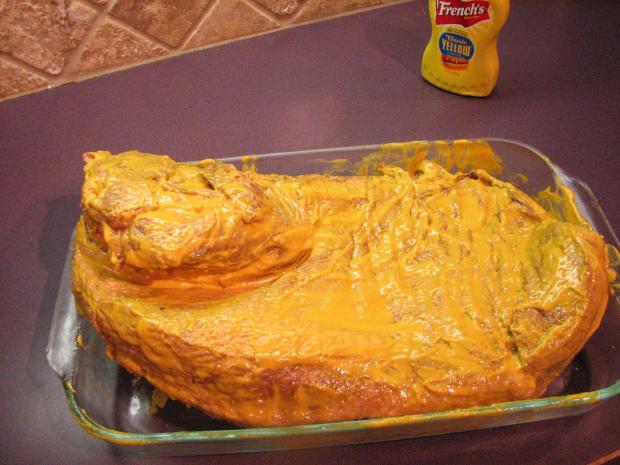
When you get a good thick layer on it, grab your favorite bbq rub and sprinkle it LIBERALLY all over. You don’t have to use the Arcadian Rub, but you want to make sure you use one with some brown sugar, salt, and spicy cayenne. You know what? Just use the damn Arcadian Rub.

Flip it over and get the other side as well (fat cap back down). DON’T RUB IT. Just sprinkle on top of the mustard. If you’ve disturbed the mustard coating, make sure it’s even and then re-sprinkle to cover.
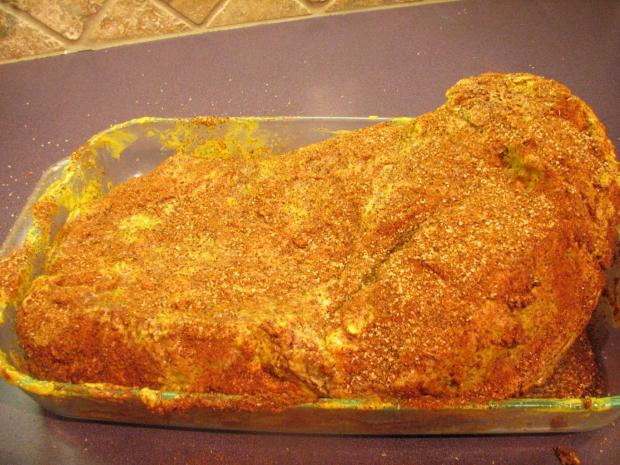
A close-up:

Now, we need to put this back into the fridge overnight. Don’t skimp. Needs to be overnight. If you put it in unwrapped, though, your fridge is going to smell like this for weeks, so grab a new trashbag (unscented) and put the whole thing in, pan and all. Seal it up and let it sit in the cold.
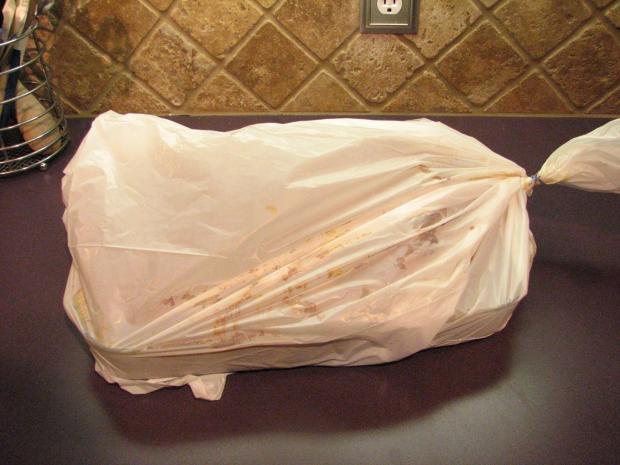
After a night in the fridge, poke that bad boy’s head out and take a look. The rub has gotten wet with the mustard and has made an incredible coat around the meat. That will be important for the next few hours as we slow smoke this

Close-up:

When you take it to your smoker, make sure you’ve let your smoker go enough so you are regulated to about 225deg constantly. Don’t try to singe this or sear it at first. It’s totally unnecessary, despite what you may hear from BBQ “experts” on tv. Just make sure you have a hard rolling smoke going, and your temp is around 225deg. 250deg at the highest.

I’m using mesquite.  Not pecan and especially not oak, which is good for firewood and that’s about it.  Use mesquite wood on your beef.  I could almost accept someone mixing in some pecan, but it’s not needed.  Just use mesquite.  Stop asking questions.  Use mesquite.

Put it into the grill with the fat cap UP. UP.

There are differing opinions on whether or not you should smoke fat side down or up. The folks who say “down” say that it helps keep the meat from charring. However, it you run your smoker right, it should never char since we aren’t getting above 250deg. Also, if the cap of fat is up, then it will melt down inthru the meat fibers, coating them with the delicious fat and Allegro brine. Does it matter? In the long run, probably not. However, this is how I do it and I know it works. Try it this way and see if it’s not good. If not, do it however you want to do it. This is America, baby.

After 4 hours:
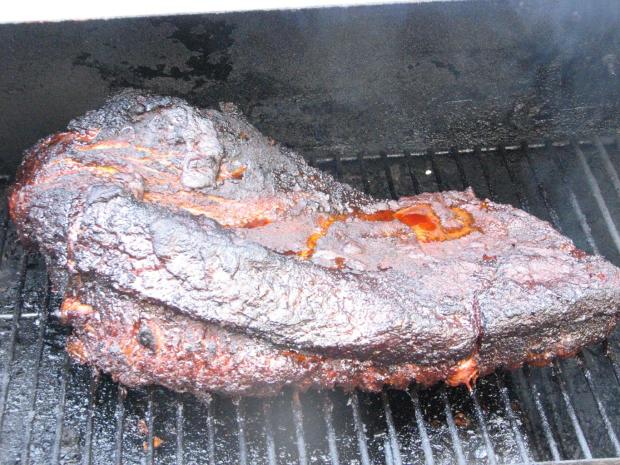
After six hours (with a couple of sweet potatoes thrown on to smoke for dinner):

You notice how black it is? That’s GOOD. We call that “bark” in the BBQ world. It’s the blackened layer right around the outside that has all the seasoning flavor from the mustard mixed with our rub. After six hours, we need to wrap this. You can go a little longer if you like, but I think six hours is plenty.

Get your handy prep table out, and lay two layers of heavy duty foil (the long package). Lift your brisket right out of the grill and onto the foil.

Fold the first layer of foil around the briskets. Fold it TIGHT and do it so that all corners are covered. I start at the bottom, fold across like you are putting a diaper on a baby (old style diaper on a baby, that is).

Do both ends, tucking in each loose piece, pinching them together, and making sure they are sealed up TIGHT.

When you get it all sealed up, a nice fold or pinch will keep it together. Just like a good marriage.

You might have some spots left exposed after the first wrap. No worries..we’ve got three more layers to go. Second layer from the bottom:

After both bottom layers go on, take another large piece of foil and wrap all the way around the top, covering that hole at the top, tuck under, but make sure you fold corners so that it fits like it should. Do that twice. You should have used four sheets of foil so far.
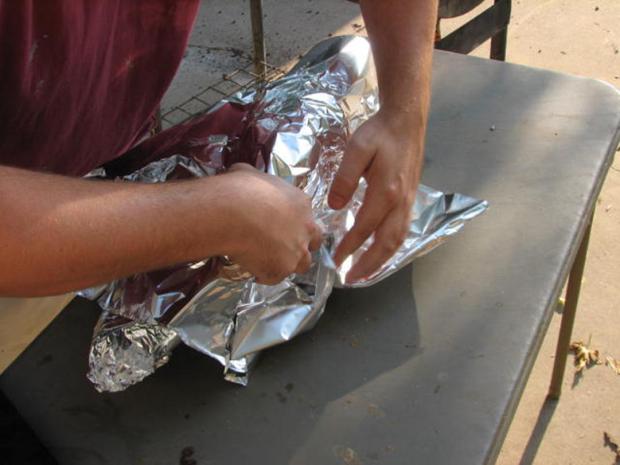
Then you’ve got your tight wrapped brisket, ready to go on for the long burn. Again, make sure you are watching your fire constantly and keeping it between 225-250deg.
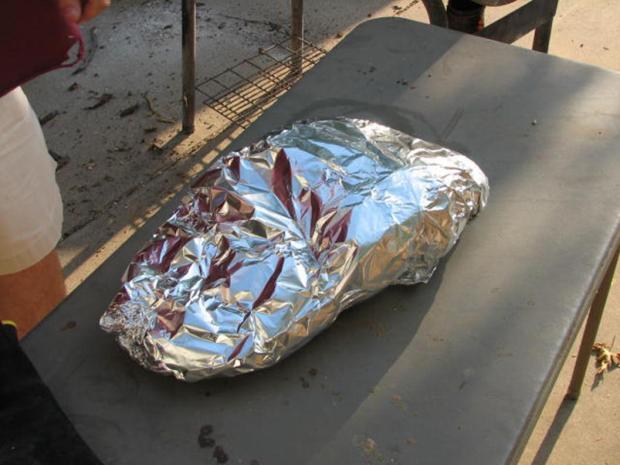
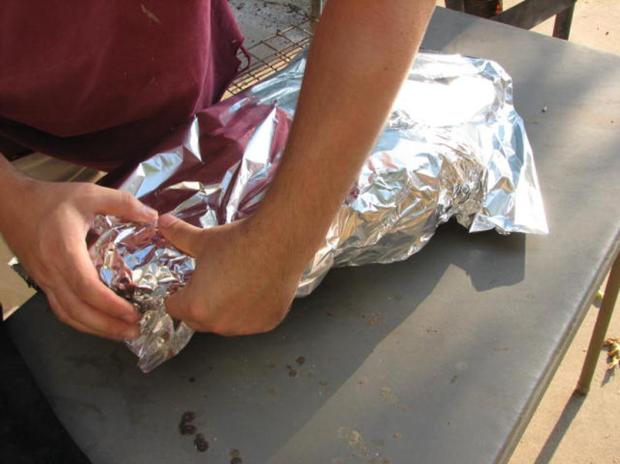
Back on it goes. Let’s add up the time so far:

-Allegro brine (4-6 hours, potentially overnight)

-Mustard and rub down (overnight)

-4-6 hours on the smoker at 225-250deg.

Up next, this needs to go for 12-14 hours wrapped at the same temps. Crazy, right? Yeah, just trust me on this.

After the smoker has done it’s work, the pretty foil will go from a nice golden yellow to a dark brown.

After 12-14 hours, take the entire brisket and place it in to your BBQ Cooler and let it rest for up to seven hours.

Do NOT open the cooler or disturb the foil until you are ready to cut.  That’s important.  Let it rest, and the rest is just as important as the other steps.  Don’t skip on this…let it rest.  Up to 7 hours max, no less than 4 hours.

When you are ready to carve, here’s a little trick.  You’ve got the fat side up still, so reach into the cooler and either rip the foil with your fingers or take a knife and cut the foil open.  You should be able to pick it up from underneath and flip it out onto your carving board.  However, get a pan so you can collect the drippings before you flip it out.  I use the same pan that I used to marinate the brisket.  Just tip it so the drippings run out, flip your brisket out onto your board, and then collect as much of the drippings as possible.  If you have some drippings that come out onto the board, go ahead and try to rake those into your pan also.  It will make the carving so much less messy.

Big ol’ slab of beef.

From the bird’s eye view:

When you start to cut, keep in mind how the meat fibers run.  Again, we are going to cut against the grain.  There’s a little secret to make sure you do this correctly.

a) start at the “skinny” end of the brisket

b) start on one corner, where you think you need to start

c) cut off the top of the corner on a bias (or on an angle) to make sure you are starting right.  If you chose the wrong corner, you can easily go to the other corner w/o too much of a do-over.

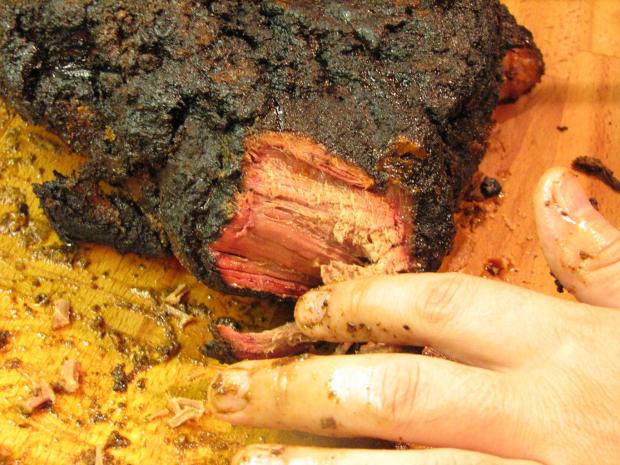
How do you know if you’ve cut it against the grain?  The part you cut should fall apart, with the meat fibers being really short.

I like to use an electric knife.  Honed steel is good, but don’t foresake the precision of an electric knife here.  Start making about 1/4″-1/2″ slices along that same line that you started on just a bit of a bias.

Excuse the blurriness, but you get the idea.

This is what I’m talking about being “against the grain”.  See the short meat fibers now that seem to fall apart?  That’s what you want.  This will be so tender that the meat will literally fall apart when you try to pick it up.

Here’s your brisket slice, about as whole as you can get it.  It’s ok if it falls apart.  It’s going to be so good and tender, it doesn’t matter if it stays in long slices.
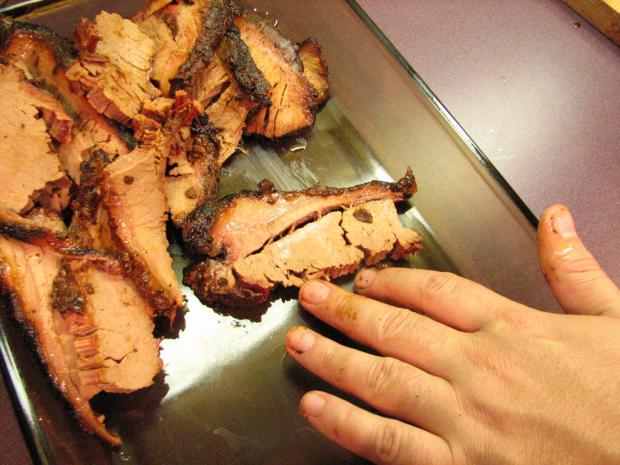
Continue on until you get to the point where the meat fibers begin to turn.  You’ll know you are there when you get to the big thick part of the brisket, and your slices look like they are slanted.  Then, turn the brisket 90degrees and start cutting right across the top, which will now be against the grain.  You’ve got two different muscles in here, but they’ll both be going the same way.

A close-up of the muscle, with a thin membrane separating.

Here are the long meat fibers.  Cut against then so your knife is perpendicular to the muscles.
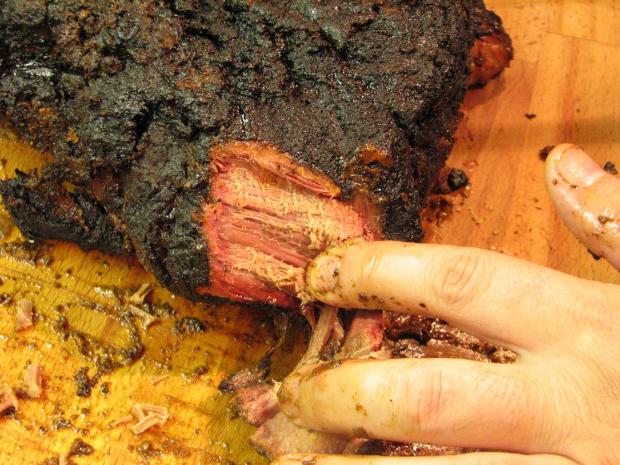
Close-up, of the slices.
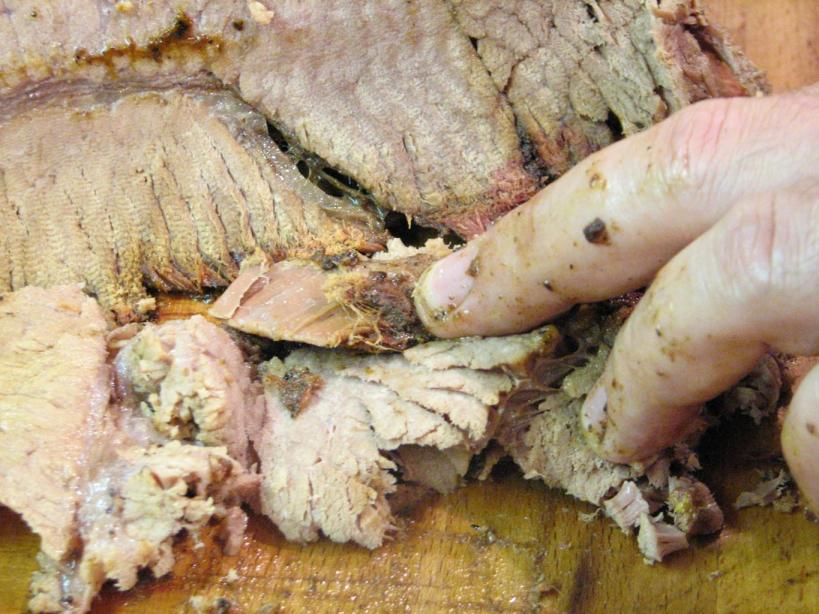
When it’s all sliced up, you have should be able to peel some of the extra fat off and keep it in a pile up at the top.  Plus, you have tons of extras left over.

There’s all the brisket cut up.

That fat still has tons of potential to it.  Let’s not throw it away.

If you take your fat trimmings and put them into a skillet, you can start to render some of the extra fat off.  Brown on both sides for a bit…
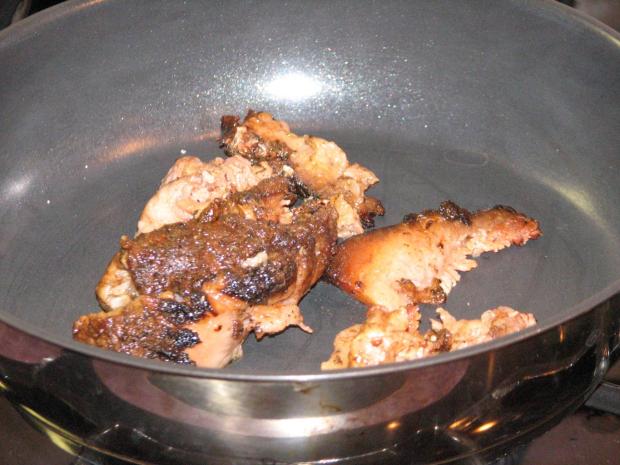
Then add a little beef broth or some of the drippings back to the pan and let it suck as much of the fat out as possible.

Then take that hot grease and drippings and pour it right back over the sliced brisket.  Cover it with foil, put it into the oven at 170deg for a few minutes just to keep warm until it’s time to serve.

Presentation on the plate:
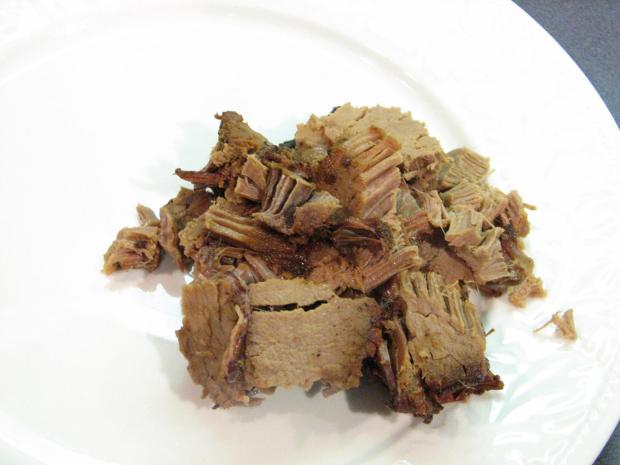
In the pan, you’ll have this deliciousness:

I’m not opposed to putting sauce on this, but if you are going to use sauce, let’s use the WGD brisket sauce and not just some sugary sweet crap off the shelf.

That’s it.  My dad’s mustard brisket, cooked for a full 24 hours and about as perfect as Texas BBQ can be.