Spring is Here

Spring is here in North Central Texas. It is obvious in all the sprouting and flowering plants.

Icelandic Poppy
Daffodil
Ornamental Pear

The winter wheat practically glows in the sun. The daffodils are a bloom and the perennials are starting to come back to life. But I happen to have a greenhouse so I’ve got a bit of a jump on things.

Today it was 78 degrees. It’s February 28. I don’t know what that is going to mean but I don’t think it bodes well for the garden season this year. We’ll see.

But for now I’m happy with what I got going on in my little garden.

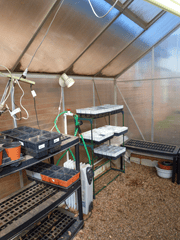
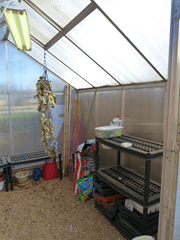
View into the greenhouse to the left.
View into the greenhouse to the right.
The herb project.
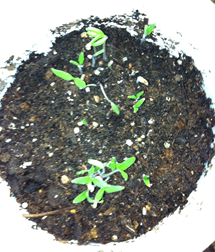
Someone spilled some of my seeds ... I'm not saying who (Jdubs) but I didn't want to throw them out so I just stuck them in a pot to see what sprouted. I have no idea what this is, maybe tomatoes or peppers
A little tomato is forming. And considering how warm it's been, early season is best.
More tomatoes ... these are Celebrity.

My Dog, Ruby

Ruby is a great dog; she’s my dog. I got Ruby in January of 2005 as a little puppy. At the time in my life I needed a companion and a loyal friend.

She is a loving, obnoxious canine with OCD. An Australian Shepherd, she is a working dog, and loves to play ball. I’ve never seen a dog play fetch like this dog. This is a photo blog of Roobs.

The ball.
Next to my bed.
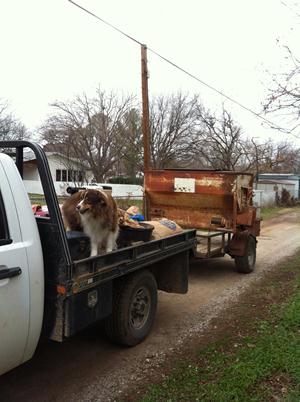
Getting to go on the feed wagon.
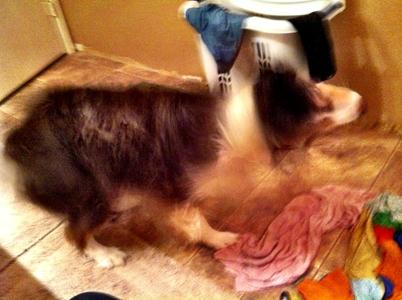
A good shake after a Christmas Bath.
Jack and Ruby on the feed wagon together.
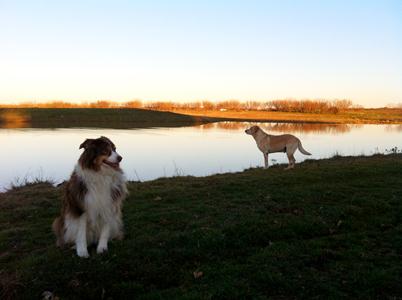
Ruby and Jack on a beautiful day.
Ruby wanting to come in.
Her other favorite pastime -- chewing her bone.
Photo bomb -- Ruby is also a garbage/begger dog.
Always my companion.

Murphy Monday

Murphy’s Law ruled today … Sometimes you just have one of those days … and today, Murphy showed up. Every fool thing, one after another, went haywire. (Although you rarely see hay with “wire” anymore.)

At 3:30 I stepped in steaming pile of dog poop and said “That’s It!” (really I said something much more foul, but for my  saintly mother’s sake we’ll just go with aforementioned quote.)

Let’s recap… on second thought … let’s not.

Translation= 400 words into my diatribe, I hit the delete button.

I’m going to take my horsepill of sinus-infection killing antibiotic, then off to bed to hit the restart button.

875 Mg of Gastrointestinal un-awsomeness.

I will say … the day ended up OK … with my lovely husband giving me flowers – thanks babes!

My sweet husband continues to put up with me. God bless him for it too. I'd be lost without my man.

Spring: It’s Coming

I started cleaning up and getting my greenhouse ready to start seeds. Today is February 11, but our last average frost date is about March 20. That means it’s time to start thinking about the spring garden. Even as we have a harsh cold snap, I was making way for planting tender annuals from seed so we can transplant after the danger of killing frost.

As for most gardeners, my ultimate prize is a crop of beautiful, tasty tomatoes. Next week we’re taking Jdubs for a checkup at the ENT in Cowtown, so we will have to stop in Poolville on the way home to visit Wilhite Seed. Many sellers of seeds only produce a few of their own (if at all), the rest they resell from other specialized plant breeders/dealers. Wilhite’s domain is melon seeds, especially watermelon seeds. All the seeds I bought from them were exceptional quality, with near 100% germination rates.

Even my county extension agent was surprised. I have no idea what was so extra special about last year’s seed starting exercise – but everything I started from seed did really well, until the heat set in. I knew we were in for it last year when we had a 100-degree day on April 8, 2011. That just set the tone for the rest of the summer.

Last year’s weather was horrible. We had a record-setting hot, dry summer. Nothing would grow. There was no rain. It was abysmal, even the okra was eaten by the grasshoppers. Needless to say, I’m looking very forward to a better year, for growing vegetables and herbs.


Nothing says spring like the return of the birds.

That’s the beauty of spring … it’s the time for beginnings … starting seeds, nurturing and caring for them, watching them grow, then harvest. Nothing is better than eating something wonderful that you grew.

The greenhouse.
Left side.
Right side.
My seed box: organizing, sorting, planning.

More gardening posts to come …

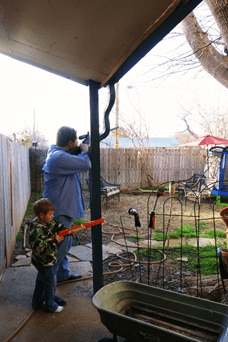
There was another squirrel in the backyard. Jdubs helped his daddy aim.

Homebrewing Beer 101: Tire Biter Golden Bitter Ale Part 1

I am a serial hobbyist. Admittedly. One of the things I love to do is learn how something works and/or take an interest in something that most people talk about but never do. In my lifetime, I’ve:

-had saltwater aquariums

-owned beehives for extracting honey

-collected sports cards, mainly hockey

-had a substantial MAD Magazine collection

-played in an acoustic guitar duo in bars

-own a full set of Callaway golf clubs in a leather tour bag

-have the best damn greenhouse in town

Those are just a few off the top of my head. At one point, I owned my own bowling ball and even have a Lionel trainset in my garage. They are all fun hobbies that there are tons of individuals out there in the world who devote their entire lives to. Now, I’ve never gone that far…most of my hobbies will either go on the back burner after a couple years or I’ll just lose interest. HOWEVER…the one thing that I love to do and have done for the better part of 20 years is:

Drink beer.

Oh, man. I’m the best beer drinker I know. I love different types of beers, from the heavy stuff that tastes like thick soy sauce to cheap Texas O.P. beer. The one hobby that I’ve often thought about but never got into was homebrewing. I have friends who have done it and have even tried homebrews. One or two were passable but the rest were downright awful. Terrible.

One night recently, I was watching Alton Brown’s Good Eats on tv, and his homebrew episode came on. Ever fascinated, I watched the whole thing and then turned to my wife and said, “I could totally do that.”

Now, normally when I come up with a new hobby, she just rolls her eyes because she knows it will either be something I forget about or it’s going to end up being something I spent time/money on. This was different. When I said it, she lit up and said, “We can totally do that.”

Bingo.

My next call was to Runnin’ Buddy. I told him my wacky idea, and he told me that he grew up with his dad homebrewing, and it just so happened that his father- in-law was a homebrewer years ago and gave him an entire set of gear to homebrew including carboy, cooker, bottles…everything. All we needed to do was clean it up, buy the ingredients, and get going.

My newest hobby was born:

Off to the big city to a local homebrew store, and we got not only the ingredients, but also some expert advice and recipes to make beer. We chose two different brews…one that should take about a month and another that will take nearly 7 months to completely age. The ingredient list:

-2lbs of milled grains

-a bucket of malt syrup

-0.5oz of Fuggles hops

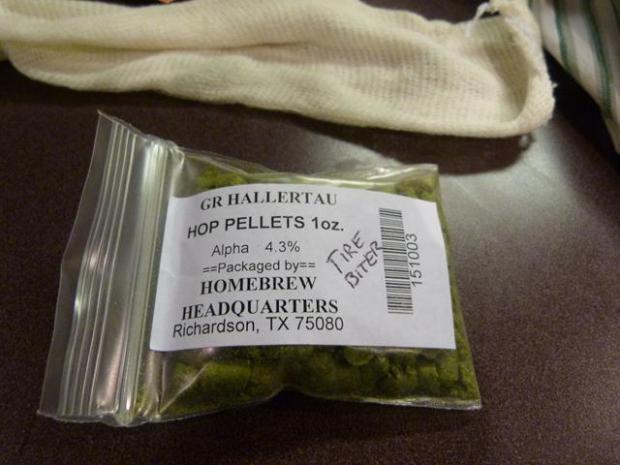
-0.5oz of Hallterau hops (that’s one of the noble hops…more on that later)

-a packet of dry ale yeast (ale yeast ferments from the top down vs. lager yeast that ferments from the bottom up, so we don’t have to stir it in)

-corn sugar…looks like powdered sugar but tastes different. It’s a disaccharide, which means that we can add it directly to the wort after the primary fermentation)

-bottled drinking water (cheap stuff..not distilled)

-cheesecloth socks for the hops

-whirlflac tablets

Immediately, you are going to be overwhelmed because we are talking about ingredients and stuff that you’ve never heard of (probably). I know I was. Stick with it, though…it’s not as bad as you think. Your homebrew store will be able to provide all of this for you and explain what it all is. If not, then go find another homebrew store.

The gear:
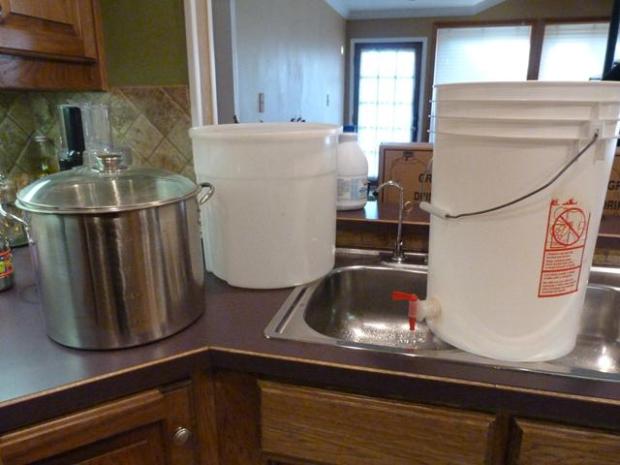
-4-gallon, stainless steel stock pot with a glass lid

-7-gallon plastic bucket with a spigot and a sealable lid

-digital probe thermometer

-assorted other stuff. What? Yeah, keep trusting me on this and read the whole thing before you start.

The very first thing you do after inventory assessment is to sterilize everything. Even if you’ve washed and cleaned everything with hot water and soap, there still may be some bacteria floating around, and even the smallest amount of bacteria can turn the beer bad fast. We mixed 2 tablespoons of regular bleach with hot water in the primary fermenting bucket and shoved everything in there that we could…corks, burper, probe thermometer, metal whisk…anything we thought we might use at any point after the boil phase, we sterilized.
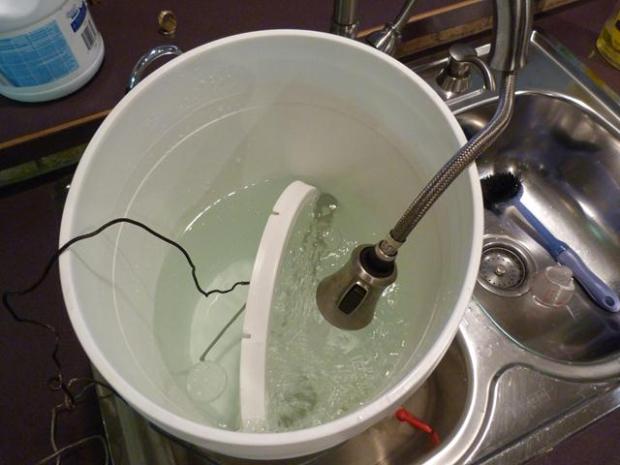
From up above:

While all that sat for 30 minutes, we started up our “brew tea”, which is a gallon of water with the milled grains seeping.

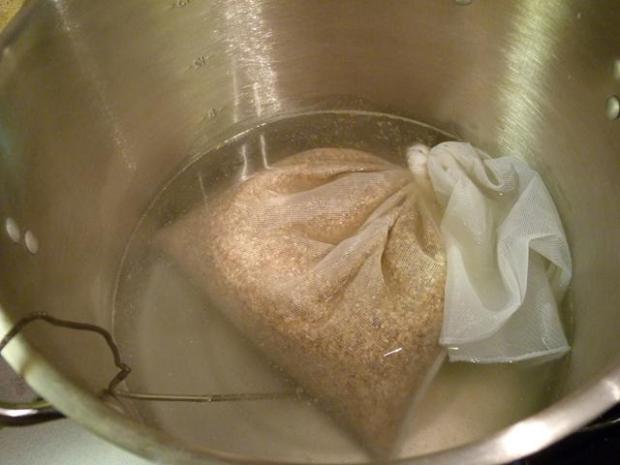
That has to simmer at 153 degrees F for 20 minutes. Why so precise? The whole grains have a lot of sugars and resins deep inside their kernels that will be really bitter if they are extracted, so if you keep the heat down they will not seep out. In addition, you CANNOT squeeze the bag they are in AT ALL or you’ll squeeze them out.

The mesh grain bag with the grains inside:

Do this over the sink our you’ll have this to clean up:
While the brew tea is making, I boiled another pot of water, then put a towel in the bottom so that the malt syrup could get hot and be easier to pour out. I’ll explain more in a bit, but the malt syrup is an extracted blend of grain sugars already pre-made by the brew store. Serious homebrewers will extract their own, but since this is our first time and since it takes about a day to extract them, we are going to just use the premade stuff. I don’t expect that to change.

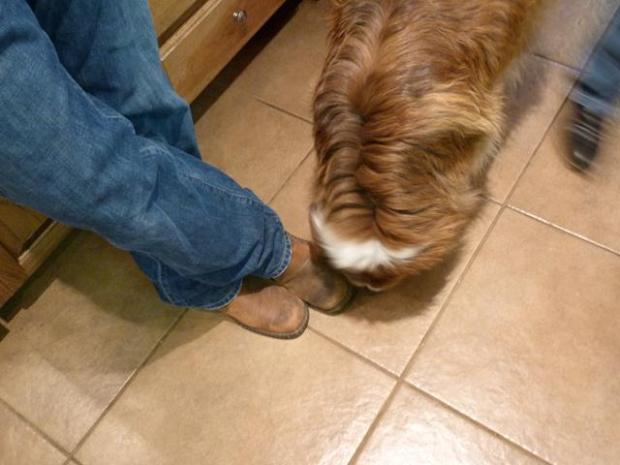
Shangri-La Dog is there to help lick up anything that hits the floor.
After the water boils, turn it off and put the uncovered syrup bucket in, making sure you don’t overflow the water.
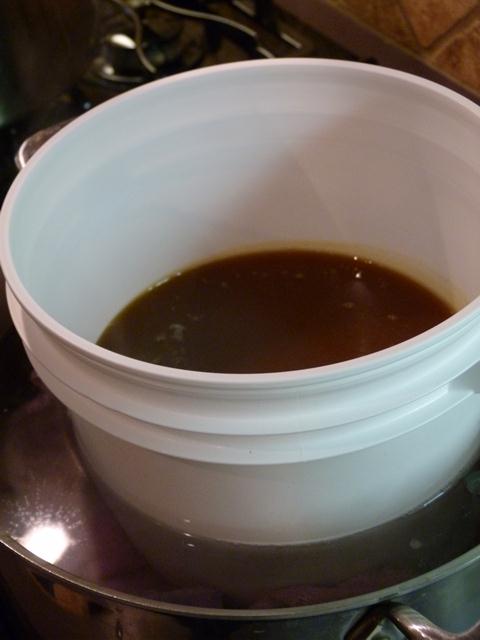
The malt is so sugary sweet, you can barely stand it. It looks like super thick honey and kinda tastes like honey a little bit, but the aftertaste is really potent. Not bad, but definitely a shock to the system when you taste it. It’s beautiful, though.

In goes the bag of milled grains.

We kept the water boiling at 153® for five minutes to make sure we could maintain the heat. As well, we gently stirred the tea from time to time to equalize the temp and make sure there wasn’t a build up of heat in one spot under the bag.

After 5 minutes, you can see the wort begin to take shape as the water turns a pretty blonde color.

Meanwhile, we took 1.5 quarts of water and heated it up to 170 degrees. We’ll use that to pour thru the tea to make sure we get all the goodies out when we are draining it.
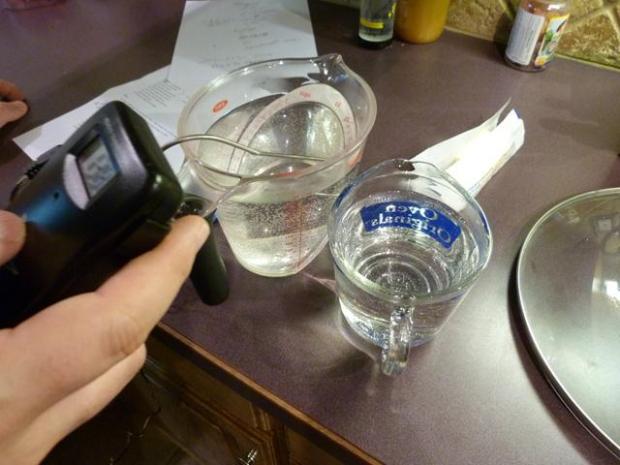
After 20 minutes, we pulled the bag and drained it. Then, we poured the extra hot water thru it.
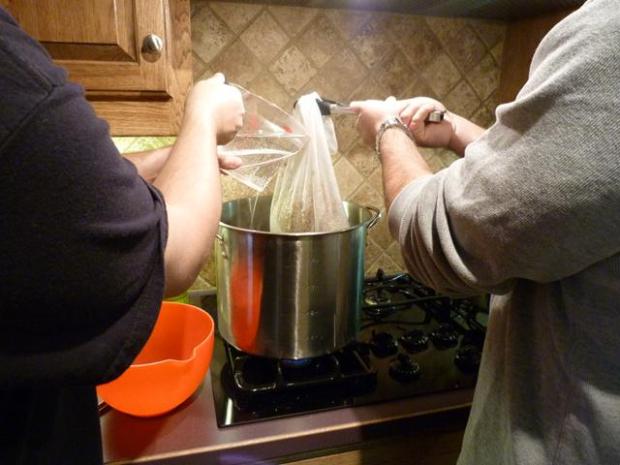
Top off to 3 gallons of water for the boil. We’ll bring this up to a boil…
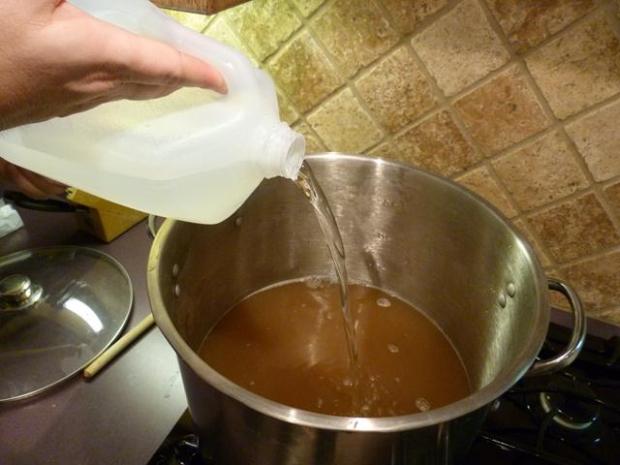
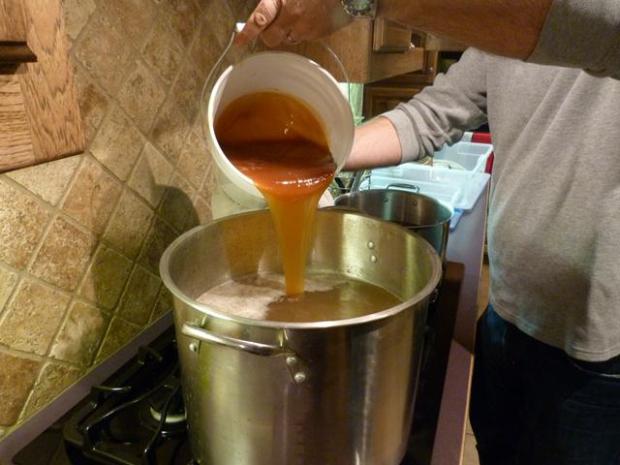
The pour in the malt syrup. It’s so thick that you have to immediately start stirring it up or it will stick to the bottom of the pot. Why do I know this? you might inquire? Later.
After we bring that back to a boil we are going to had the hops. Remember up top, I mentioned we are using two different types of hops. “Hops” are the petals of a flower from a plant that is the same family as marijuana (no lie). Brewers have used the petals straight in for years, however they now concentrate them into pellets for homebrewers. I’m sure real beer makers do the same, but we for sure are going to. There are four types of “noble hops”; those are the original hops that were first used:

-Hallertau Hallertauer Mittelfruh

-Tettnanger Tettnang

Spalter Spalt

-Saaz

They are all grown in central Europe and are the standard for Bavarian style beer. Other hops varieties are grown all over, but the noble hops are considered the grandfathers of beer flavoring/finishing. Today, we are using a British hops called “fuggles” (leave it up to the Brits to come up with a goofy name) and the noble hops, Hallertau. We’ll do this in two stages: flavoring & finishing/aroma. The fuggles will boil for 75 minutes and add a big robust flowery flavor. The Halltertau will only be in for two minutes because we just need the aroma and oils to give a bitter punch that this recipe calls for.

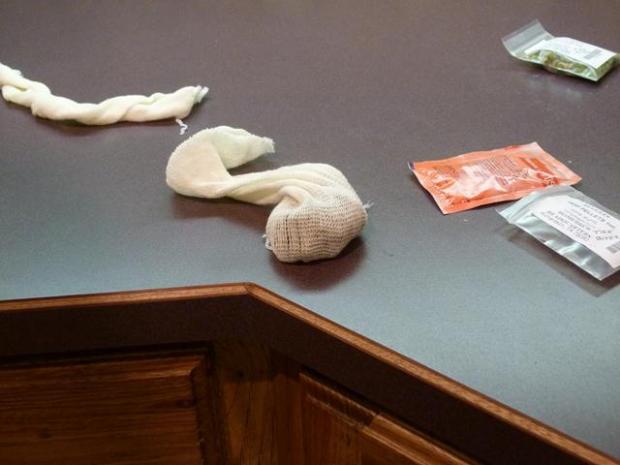
We’ll put those into a cheesecloth sock, darned at one end and tied off at the other end. The pellets will swell up and expand pretty big as they cook, so we need to give them plenty of room to grow.
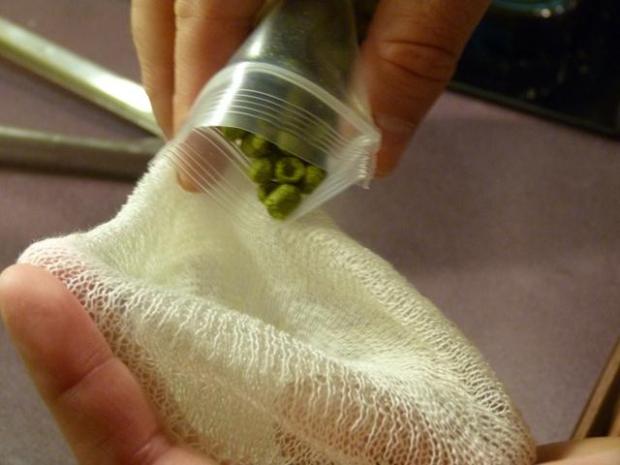
The boiling wort (which is what you call beer before it’s finished):

When the rolling boil begins, we throw in the fuggles and let them cook.

Now, I wish I could explain to you how great this smells. The malted barley and Munich grains that are in the bag smell like Grape Nuts if you’ve ever had them cooked. The hops smell so good…it’s like perfume, but with an anise kick. It’s so strong when you first open the bag that it takes you back, but you immediately get right back in for another whiff.

After 60 minutes of boiling on the flavoring fuggles hops, we need to add whirlfloc. Whirlfloc is a synthetic additive that doesn’t affect the smell, taste, or flavor of the beer at all. What it does is grab on to all the suspended particles in the beer and make them heavy enough to sink to the bottom of the primary fermenting bucket. If we were making a dark beer, then this isn’t an issue. However, with a lighter golden beer then we are probably going to see particles in the beer if we don’t filter it. Since we don’t want to filter, we use whirlfloc. Purists will use Irish Moss, but we’ll just use whirlfloc for ease of use.
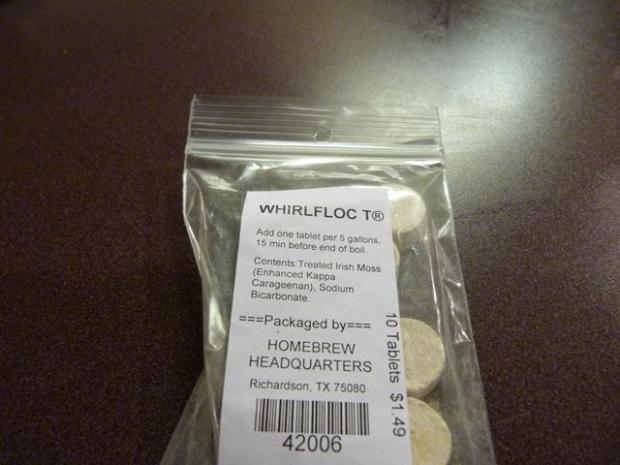
After 13 more minutes, it’s time for our finishing or “aroma” hops. The first hopping gives flavor. We go with a more potent hops to add the smells of the hops only. For this, we are using the Hallertau:

Two bags of hops.

Notice the line on the inside of the pot where the original level of the wort started. We’ve reduced down considerably, concentrating the smells, sugars, and flavors of the wort.
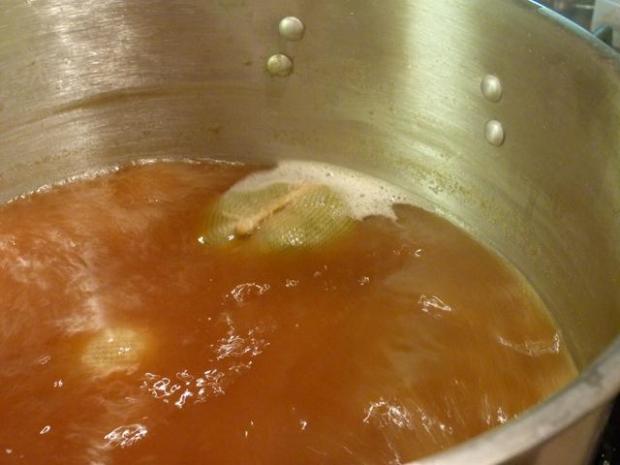
The finishing hops stay in for two minutes, then we turn off the heat and pull the bags.

The wort will continue to churn for a bit with the carry-over heat. If you taste this now, it tastes like sweet bread that you’ve liquefied. Big flowery taste with a bit of bitterness on the back of your tongue from the hops.

We let this cool down for 15 minutes in the pot. Then, we took 8lbs of ice and put it into the sterilized primary fermenting bucket with the spigot turned off so it doesn’t run all over the floor.

For reference, by the way, we cut the hops socks open to take a look at the hops after the cook. The flavoring fuggles hops are on the bottom and are a noticeable browner color, as we’ve cooked a lot of the chlorophyll out of the flower. The aroma hops are on top and are still bright green.

The grains that we seeped for the brew tea look like cattle feed, and frankly kinda smell like cattle feed, too. We’ll set those out in the fancy greenhouse to dry and will put in the birdfeeder.

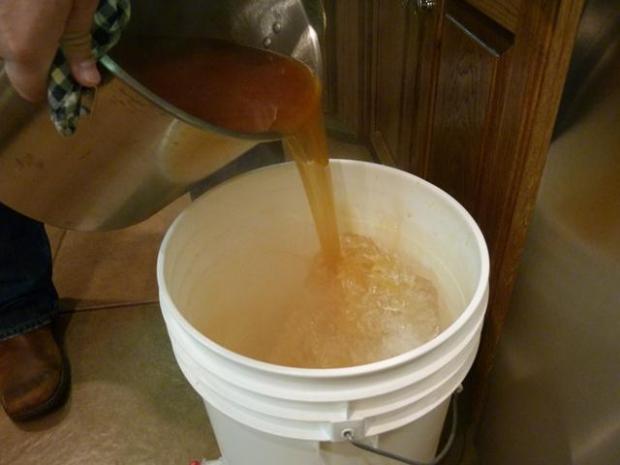
Pouring the wort into the fermenter…look how beautiful that is.

Pouring it over the ice will help melt it.
Remember what I said about having to stir the syrup well or it would stick to the bottom and burn?

Damn, I hope that doesn’t come back to bite us down the road.

Topping off with another gallon of water to make five gallons total in the fermenter (

The wort in the bucket:
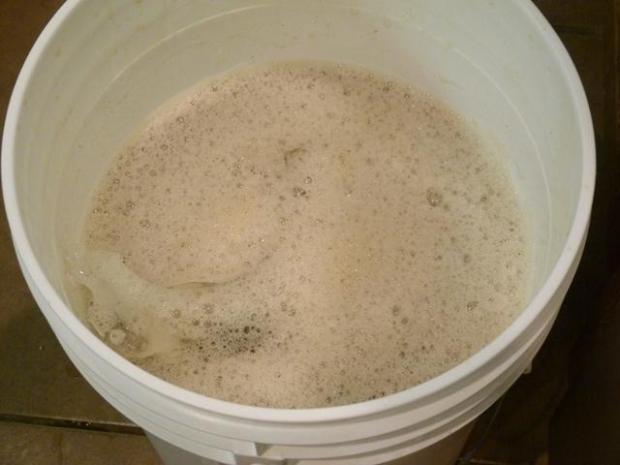
We have to let this cool off to somewhere between 65-75 degrees before we “pitch” the packet of dry yeast. If it’s too hot, then the yeast will immediately die. If it’s too cold, the yeast could die or just be arrested and not bloom.

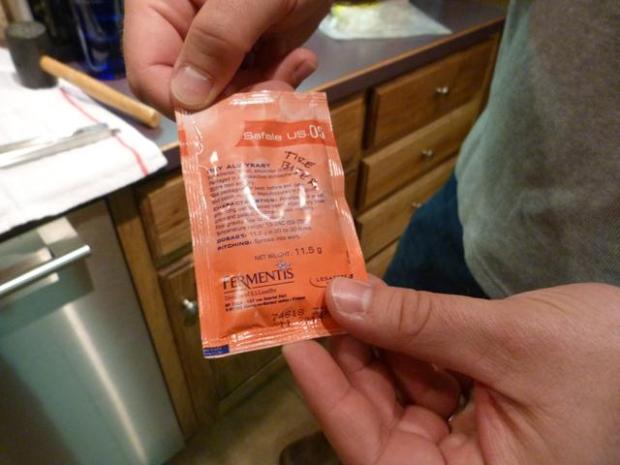
The packet of yeast
“Pitching” the yeast into the top of the bucket:
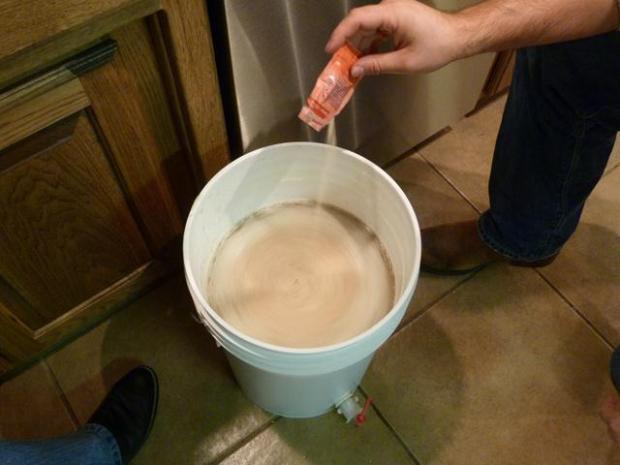
Now, we do NOT stir this up. Because we are using ale yeast, it needs to sit right on top to work. The yeast feeds on the sugars in the wort and craps out air and alcohol as a natural process. We need the air to escape in this portion of the process, but want to keep all the alcohol. We do this by sealing the top of the bucket except for a small hole with a “burper” or an “airlock”. This will slowly let air out while not letting any back in. Air has bacteria, and we don’t want that.

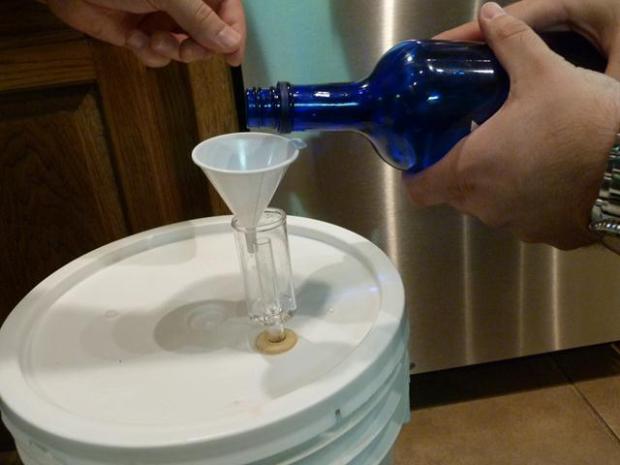
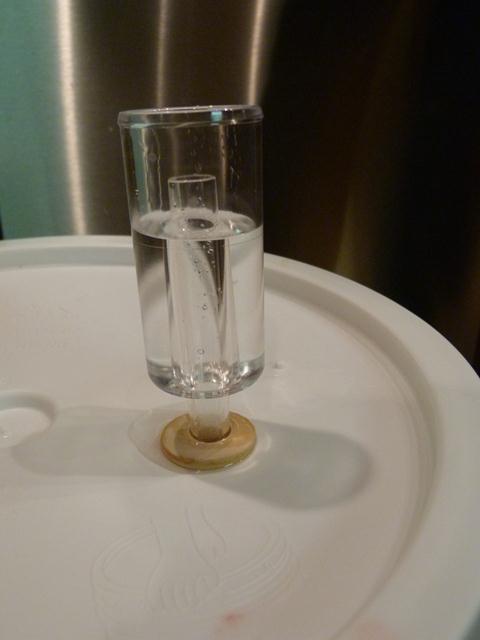
Alton Brown tells us to add water into the airlock to make bubbles, but the gearheads go one step further. If you use vodka in the airlock instead of water, then it keeps it extra disinfected. It just so happens that I keep vodka laying around for just such an occasion.

Carefully pouring it into the airlock chamber.
Upright.
Knucks for a finished wort

Here comes the tricky part. We’ve got to let this ferment for 10-20 days in a dark cool place, no hotter than 70 degrees and preferably around 60 degrees. It just so happens that we have a coat closet that stays at 62-65 degrees at all times

That’s our first part. There are two more parts on the way, but you’ll have to wait for a couple of weeks for the wort to ferment.

To be continued…

Music and Theater in Arcadia

We have a wonderfully restored theater here in Arcadia … it’s grand and musicians, thespians and one-act play troupes alike comment on its greatness. (And it’s here in po-dunk, just another gem that few outside of our town know about).

Most of us who live in an arcadian utopia couldn’t go to the theater, to concerts, to plays– either the ticket cost or logistics of travel keep us from such cultured enrichment.

Every year the Graham Concert Association puts together an incredible series of performing arts that is a true service to our community because it brings the arts to us.

The quality of the performances and the variety is incredible. The concert association has hosted children’s theater, symphony orchestras, Grammy-award winning musicians, and performing artists from around the world. It’s underwritten by many donors in our community.

You have to purchase a season pass, but they have student pricing available for kids. The price of a season pass is less than a floor seat at a hot concert in Dallas. A season pass is worth every penny to be able to see and hear all the wonderful artists, experience the talent and culture right here in our home town.

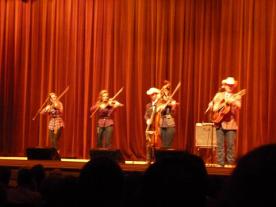
Tonight we saw the Quebe Sisters Band … Wow. (more on that in another post.)

Victual Files: Another Hole in the Wall

If you weren’t going to Newcastle, Texas, you probably wouldn’t have much of a reason to be there. It’s up on the tip of the rolling plains where the hill country turns into dusty west Texas. Around 1950, the town had about 1,500 people living in it, and was a thriving coal mining community. However, they long-ago closed the coal mine, and since there’s not a railroad anywhere close the town’s citizens are mainly those who either are from Newcastle or whose parents and grandparents are from Newcastle. They sit below 500 these days on total population, however something very magical happens in the Fall in that part of the world.

The deer hunters converge.

You see, along with sparse population comes wide open range, and it just so happens that the nearby Brazos River makes for some of the best deer hunting in all of north Texas. At one point in the last century, the area was also known for its incredible dove and quail hunting. However, due to environmental changes, the dove population tends to wain from year to year, and the Bobwhite quail population is close to 25% of what it was just 50 years ago.

Nonetheless, on weekends in the Fall (aside from some of the best 6-man football in the region), you’ll find the town almost doubled in size with four wheel drive trucks, ATV’s, feed corn, and camoflauge from head to toe. You can buy beer and liquor from the stores, and the gas at the gas station is some of the cheapest around. If you venture into Jerry’s Meat Market on the corner of 380 and 380, you can get incredible cuts of beef ribeye steaks, marbled to perfection and cut in the butcher room in the back.

However, across the road there sits a red building that locals know as the local eatin’ joint, and visitors know as the home of the best damn hamburger on Earth. This is: Another Hole in the Wall.

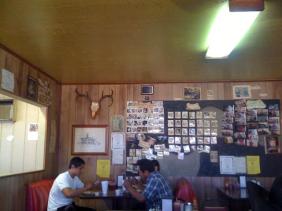
Oh, sure…there’s a drive thru if you are picking up groceries for the family after church on Sunday, but you’ll want to go in to experience what AHitW is all about. In addition to their hamburgers, they have a yearly Big Buck competition and a longest turkey beard competition. Adorning the walls are pictures from previous years; a “yearbook” of sorts showing trophys pre-mount of all the harvested deer and turkeys from the local hunts.

Understand that this isn’t the place to go for a prom date. It’s good food, good company, and all within the close confines of your friendly Newcastle neighbors.

You want coffee? Serve yourself. Cups are on the wall.

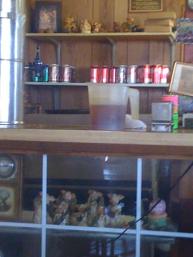
You want tea or cokes? The owner, Bob, offers that, too. He will refill your tea glass for you, but it’s all unsweet so you have to spice it up yourself. Cokes are charged by the can, and they have three or four different types of “cokes” here. (In Texas, any type of soda is a “coke”. We often ask, “What sorta coke you want? Dr. Pepper?” )

Bob will even sit with you to discuss OU football or the Cowboys, but if you don’t like cigarette smoke, I suggest you sit along the edges or even the front area. This is his restaurant, and by gawd he’s going to have a cigarette while he’s working.  You can always get your order to go if the smoke bothers you that much, but it’s worth the pain to have this food served right off the grill.

Another Hole in the Wall is named as such because it was the 2nd location of a restaurant in nearby Graham called Hole in the Wall. The owner opened this location in Newcastle, however the original Hole in the Wall is long gone and all that’s left is the sequel. The be frank, the Newcastle location was always the better of the two. When you walk in, you get a menu with an angry looking character on it. Now, AHitW is world famous for its Hog Burger. The Hog is the unofficial mascot, which you’ll find on both the menu and t-shirts available behind the counter.

There’s a daily special along with a list of different regular menu items. Breakfast is served early, and lunch and dinner menus are the same. You can even get a Peanut Butter and Jelly Sandwich, but as the menu warns, it’s $21.49 and takes up to 30 minutes to prepare. I’m sure it’s good.

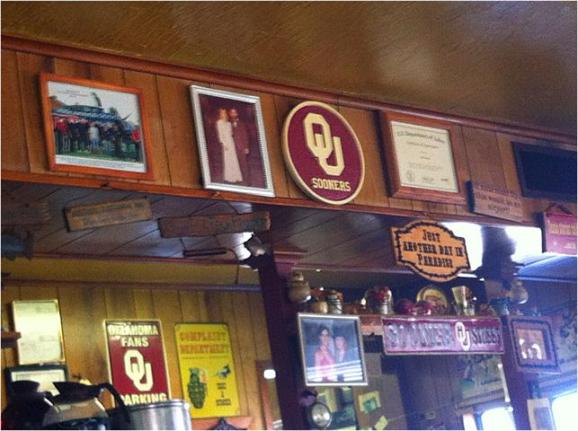
Above the front desk, you’ll see Bob’s wedding photo and his prized Sooner gear. He lets Aggies, Raiders, and Longhorns eat there, but he’ll make sure you remember who won the most recent game.

Aside from the charm and décor, we are here for the food. I mentioned earlier that the burgers are the best on the planet. That’s no hyperbole…they are the best. They are all made to order per your specification, and aren’t stuck on the grill until you order them. In addition, you can get fries, but what you want are the “house chips”: thinly sliced potatoes, fried to a crisp. They are incredible. I think I could eat an entire bucket of these things before I gave up.

If you are hungry, get the mini-cheeseburger. If you are really hungry, get the regular cheeseburger. If you think you are a man, get the Piglet (which is what we are having today). You think you are a badass? Get the Hog. The Piglet is the mini version of the Hog, but you’ll feel your cholesterol and blood sugar spike after eating either one.

This is the Piglet with house chips:

It’s a regular hamburger with bacon, cheese, and a thick slice of grilled ham. A true “ham burger”. Those delicious chips:

I take my Piglet with mayo and all the vege.

This thing is massive, and it’s the smaller version of their famous burger. If you can get your hands around it, you may have to give it a squeeze to get it into your mouth.

I like to take some of the ketchup on the table and squirt it on to my chips, then dab a little of the ketchup onto the burger.

I’m telling you…this is the best burger you can find. There is no better burger than this thing.

For the little guy, he gets the mini with fries:

…and shows his appreciation with a hearty single Gigger. You’ll notice Bob in the background having a smoke and watching TV:

That, my friends and fellow Arcadians, is what small town is all about. Good food, good company, and an experience you won’t soon forget.

Another Hole in the Wall Café

510 Houston St

Newcastle, Texas

A Christmas Bath for Ruby

I love my dog. Ruby is smart, obedient and eager to please. She’s beautiful, intense and energetic and sometimes obnoxious, but she’s very loveable. And when Australian Shepherds are described, loyal companion is always part of the discussion. She is “my” dog. She follows me everywhere. Any room I’m in, so is she. I go into the bathroom, she follows. I lie on the couch, she’s next to me. In my office, she’s curled up next to my chair. That kind of devotion is both annoying and endearing.

I got Ruby when she was 8 weeks old in January of 2005. As a little pup, she wanted to play and please. At the time, I was single and needing a friend, a running buddy, a companion full of energy, who could go on a run and be my loyal sidekick. Ruby was that wonderful friend. I promptly took her to obedience training and she excelled, like most dogs of her breed. I planned to take her to agility training and to make her a dog full of tricks.

Then, ironically, my life changed in a good way when I met my human partner in life. I decided a good dog with good obedience skills and a few tricks was perfect.

Ruby is a beautiful dog—Red Tri Color Australian Shepherd. Her beauty is derived mostly from her spectacular coat. Her breed was developed as a working heard dog; breeder selection had everything to do with how the dogs functioned – how smart and independent they were while being obedient. Other characteristics included hardiness – western cattle and sheep raisers needed dogs that would withstand the brutal climate swings and rugged terrain. And that is how their beautiful coat came to be.

She doesn’t shed too badly for a long-haired dog. But bathing this dog is a chore. We joke that she needs a “Christmas Bath” because that’s about as often as she gets a proper bath. In the summer, we just hose her down with the spray nozzle of the water hose.

But the winter is a different story. And she has been stinking up the joint for weeks now. So I finally broke down and bathed her tonight.

Step 1. Brush out some of that undercoat. (some tangles have to be cut out)

It takes many gallons of water to get her wet all the way through.

Then it takes a lot of soap to get her lathered up. Then it takes a very long time and lots more water to rinse.

And it takes about 6-10 hours for her to dry, including many shakes.

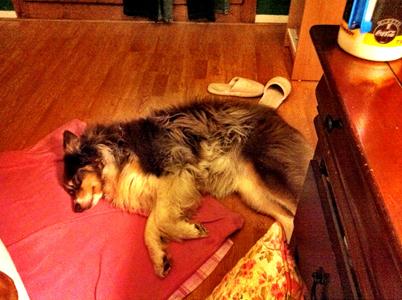
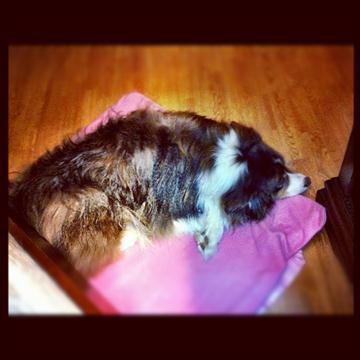
For now she’s sleeping it off.

She smells so much better now. I love my dog. And when she is freshly bathed, she is gorgeous.